Mount a TV bracket on plasterboard: stud walls and safe support
You can sometimes mount a TV on a plasterboard wall if the complete wall structure and fixings can safely carry the TV and bracket. The board alone does not answer that question. Studs, added support, total weight and bracket leverage all matter. Have an unknown or damaged wall checked first. A pack of plasterboard plugs or one general weight limit does not prove that the mount is safe.
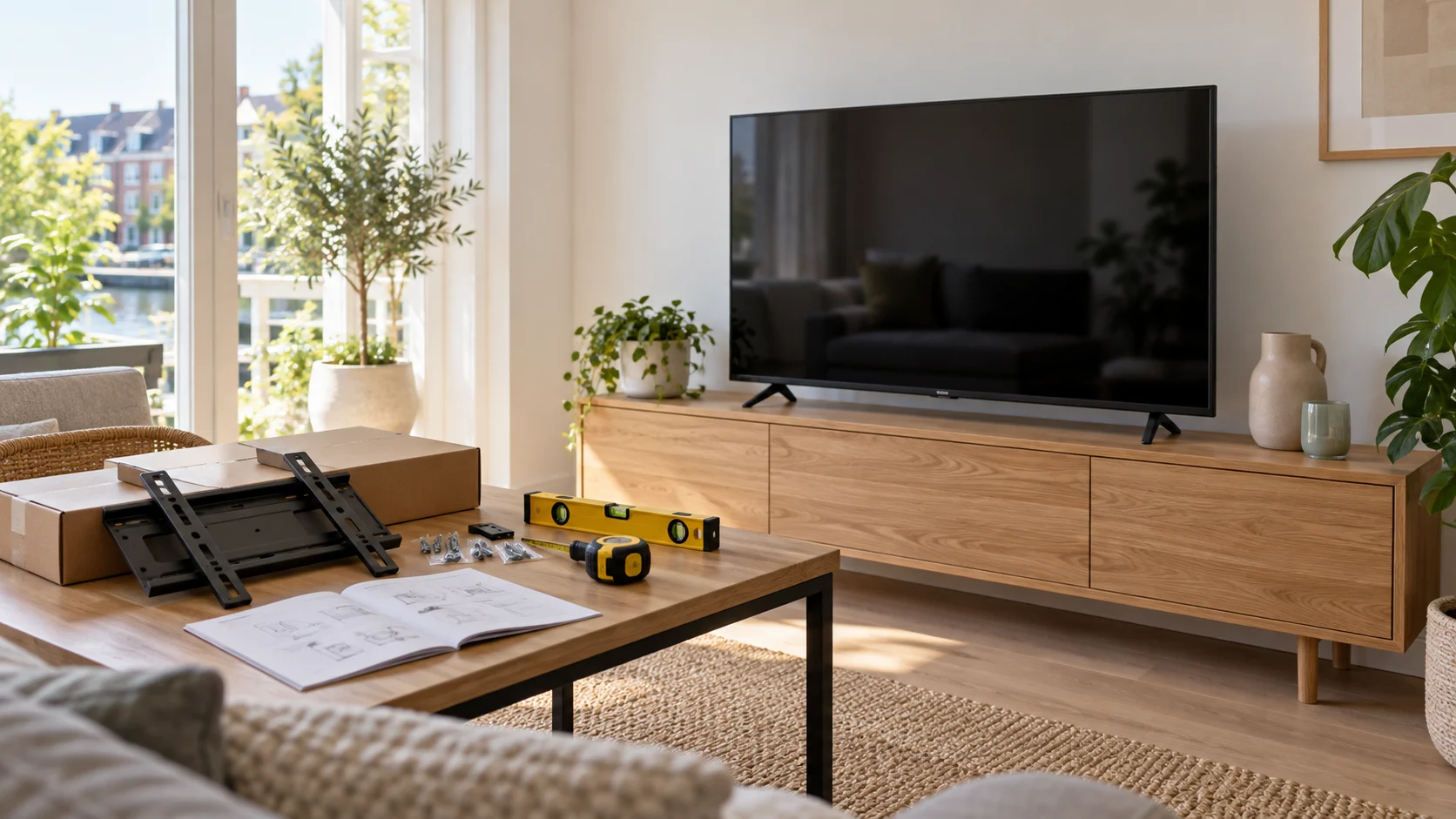
If you do not know how the wall was built, ask what holds it up. Do not use a single online weight limit for every plasterboard wall.
What kind of plasterboard wall do you have?
The term plasterboard wall covers many wall types. They may look alike, but they act in different ways under load.
| Wall type | What matters for safe mounting |
|---|---|
| Plasterboard on timber studs | Location, condition and fixing of the timber frame |
| Plasterboard on metal studs | Frame stiffness, extra loads and any added support |
| Plasterboard fixed over solid masonry | Whether the load can safely reach sound masonry behind the board |
| Hollow wall with unknown support | Whether a fixing point that can carry the load exists |
| Damaged or damp plasterboard | Wall condition must be checked before any fixing |
Use the exact bracket and fixing manuals for your wall type. One wall guide does not apply to every other wall.
TV bracket, wall and load: maximum weight on plasterboard?
There is no safe maximum weight for all plasterboard walls. TV weight is only part of the question. The whole installation carries several forces:
- Total load: screen, bracket and accessories.
- Bracket design: a full-motion arm can put more force on the fixings when it extends away from the wall.
- Support: sound masonry, timber studs or a properly strengthened wall.
- Fixing points: position and number must match the product instructions and wall structure.
- Wall condition: cracks, damp and loose boards may signal a problem.
- Hidden services: electrical cables and pipes may sit behind the surface.
All these points matter. There is no one safe TV weight for all plasterboard walls. A bracket's stated capacity also depends on the maker's fitting conditions.
Timber and metal stud walls need different checks
With timber studs, it may be possible to fix the right bracket to correctly installed structural members. The safe method depends on the frame, bracket and load.
Metal studs may need a support board that suits the wall. Do not assume that parts made for timber studs also suit metal frames. A fitter also has to check the wall frame.
Do not judge the mount by one wall plug's load rating. That does not cover the wall, bracket leverage or the pattern of fixings.
When mounting a TV bracket needs specialist advice
Arrange a wall check if:
- the wall sounds hollow and you do not know where its support is;
- you want to use a heavy screen or long full-motion arm;
- the plasterboard is cracked, damp or has been patched;
- the wall has light metal framing and no known added support;
- you want to route cables inside the wall;
- wires, water pipes or gas pipes may run behind the fixing position.
A fitter can advise on a stronger wall, a new bracket or a new spot. Sometimes the safe decision is not to mount the TV in that position.
Stop if the wall cannot be assessed or the chosen method does not meet the TV, bracket and fixing instructions. A TV on a stand that fits the TV can be a temporary option while you arrange a wall check.
First step: prepare for a wall check without drilling
You can help the fitter without testing the wall yourself:
- Take clear photos of the wall and planned TV position.
- Find the TV make, model and weight if available.
- Locate the bracket model and product manual.
- Say whether the wall seems to be board, brick or unknown material.
- Mention cracks, water damage and old holes.
- Explain any planned cable routing or socket changes.
This helps the fitter plan the check and parts. Leave decisions about hidden pipes, wiring and wall strength to someone who can check the real situation.
Fit the wall plate, anchors and screws to the wall type
The TV bracket, wall plate, anchors and screws have to suit the real structure. Parts supplied in the box may not suit every wall. Board thickness, condition and the support behind it all matter. A screw that fits one timber frame may be wrong for metal studs or masonry. There is no single safe drill size or fixing length for all plasterboard walls.
Follow the fixing and bracket makers' instructions for the exact products. Ask the installer which support takes the weight of your TV and how the parts work together. A VESA hole pattern shows where the bracket fits the screen. It does not prove that the wall is strong enough.
A stud finder does not confirm a safe fixing point
A detector can help a skilled installer locate studs behind the plasterboard or find signs of hidden services. It cannot on its own prove a secure installation. Do not use a stud finder result as permission to drill into an unknown wall. A tap on the surface also cannot confirm the frame, fixing depth or pipe routes.
Some walls have plasterboard in front of brick or blockwork rather than a stud frame. The installer needs to check how a load can reach the sound wall behind it. The easiest-looking anchor is not always an appropriate choice. Learn what the proposed method depends on before agreeing to the work.
Larger TVs and greater reach: check the bracket load
A fixed bracket keeps the screen close to the wall. A tilt or full-motion design can change the pull on the fixings. Ask the specialist which bracket fits your wall, viewing position and screen size. The required support can differ even for TVs with the same weight.
At handover, ask the installer to show the allowed movement and check the cable slack. Stop using a mount if fixings loosen or the board cracks. Do not test its strength by pulling on it. A stand or a different wall may be the safer option.
Is electrical work part of TV mounting?
A surface cable cover may form part of a mounting job if agreed. Moving a socket or changing fixed wiring is a separate electrical task. Ask an electrician with the right skills to quote for that work.
Even if the television has a normal plug, drilling or cutting into an unknown wall can still be unsafe.
Does a plasterboard wall cost more to work on?
It may require more inspection, special fixings or added support. There is no reliable flat surcharge for every plasterboard wall. A clear quote should list mounting work, wall work if needed, bracket and screws, cable finish and VAT.
The final price can only be compared once the safe fixing method is clear. A basic starting price is not the same as an all-inclusive quote for a wall whose structure is not known.
Dot and dab walls: what should the installer check?
Dot and dab describes plasterboard bonded in front of masonry. These dab walls differ from wood or metal stud walls. The installer needs to check the gap, condition of the backing and how the chosen fixing reaches sound support. A product that suits one wall type may not suit the other.
There is no general drill bit or screw length that makes this safe. Each screw must suit the specified support and fixing method; a screw that fits the bracket is not necessarily right for the wall. The bracket will need a method that fits the exact construction. Screws must be long enough for the specified fixing method, but extra length alone does not ensure the wall can carry the load. Use the exact maker's instructions and an assessed wall.
How do you make sure a TV wall mount is secure?
Only a known wall, suitable products and a correct method can support a successful installation. A straight line and tidy finish show alignment, not proof of safe support. Provide clear space for the assessment and tell the installer about damage or old holes. In each case, the actual wall and product instructions determine what is suitable. Do not treat it as a simple task because a detector shows a stud. Ask the installer to ensure hidden cables and pipes are considered as well. A popular bracket or an easy online example does not establish safe fixing points in your home.
Is fixing into at least two studs always required?
There is no universal rule for all brackets and stud walls. The product instructions and actual structure determine the required fixing pattern. A wide wall plate, extra screws or fixing directly through the board does not by itself prove suitability. The installer may need to adjust the location or choose another bracket.
Frequently asked questions about plasterboard TV mounting
A plasterboard wall is suitable only if the full structure and fixings can carry the load safely. Ask for a check if unsure; do not use one weight limit for every wall.
Can I mount a TV on plasterboard without fixing to a stud?
Only if an assessed wall and the exact product instructions support another suitable fixing method. Anchors on their own do not prove this. Some walls have sound masonry behind the board; others need added support or a different mounting position. Have the actual structure checked first.
Is a fixed bracket better than a full-motion arm?
A fixed bracket keeps the screen closer to the wall, but even a fixed bracket needs the right support and correct installation.
How do I know whether my wall has timber studs?
You cannot reliably tell from a photo of the painted surface. A fitter can check the construction while checking for hidden services.
How much weight can a stud hold for a TV?
There is no single rating for every stud. Its material, condition, connections and the fixing pattern all matter. Check the whole wall and the product instructions, rather than one load figure. Added support may be needed, or another position may be safer.
Where and how high should I mount the TV?
Start with the centre of the screen near seated eye level. Discuss your seat, furniture and bracket with the fitter. Then check whether that spot has safe support and avoids hidden services. A comfortable viewing height does not prove that the wall can carry the TV.
What should I tell the installer?
Share the TV and bracket models, photos, wall details or doubt, preferred position and cable plans. Mention any signs of damage.
Ask for help with TV mounting
A qualified fitter can review the wall and agree on a clear, safe scope. Request a quote that covers any wall check, fittings and finish.
Describe your TV mounting job or see TV mounting services.
This article was written with AI assistance.
Sources
- Wand in uw woning — ophangen en consolelasten — Knauf Nederland (2026-10-20)
- Voorwerpen ophangen aan een gipswand of plafond — Gyproc Nederland (2026-10-20)