Cleaning guide
How to remove construction dust after a renovation
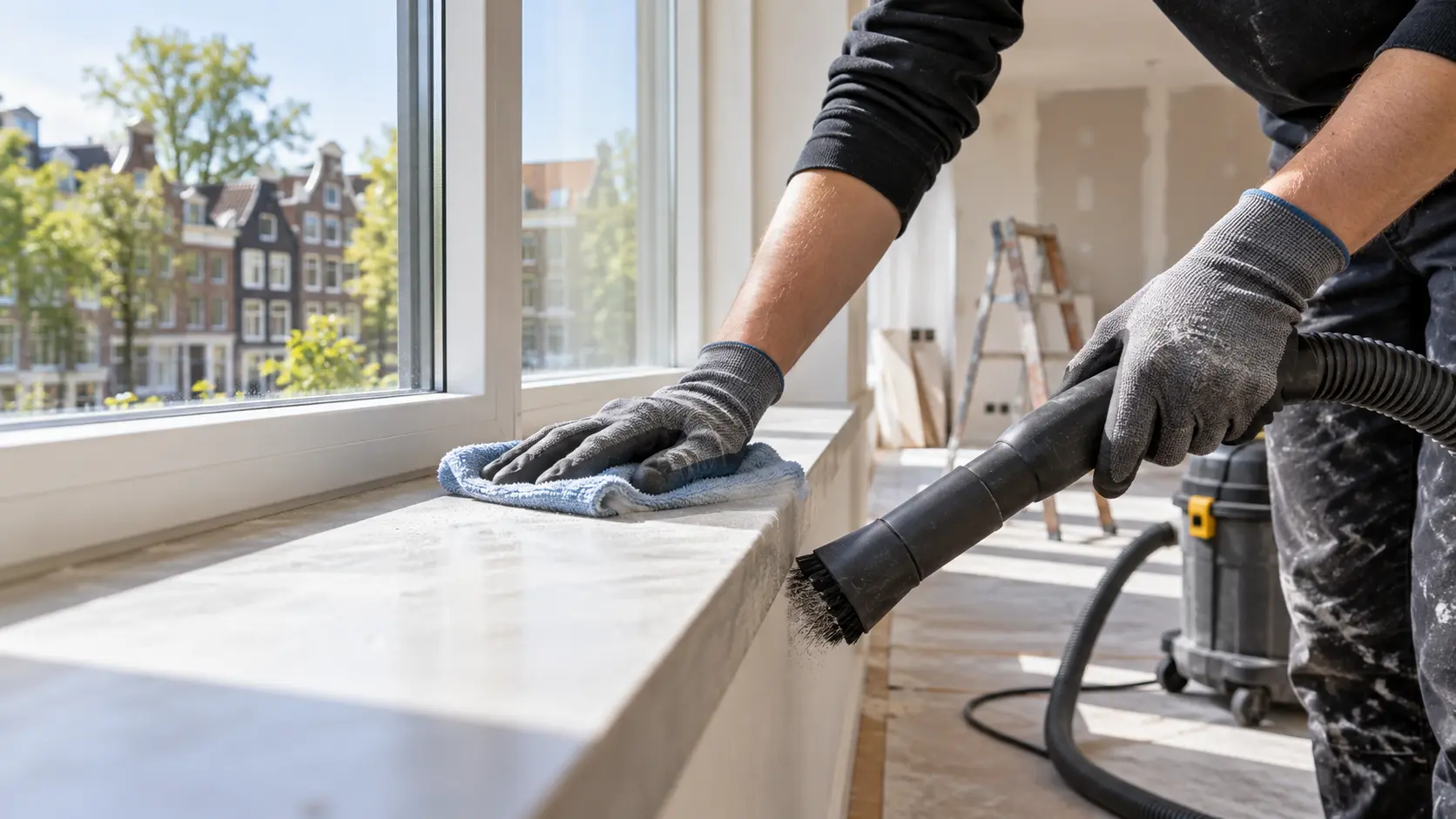
Remove construction dust damp and from top to bottom. First vacuum the loose dust with a vacuum that has a HEPA filter, then wipe every surface with a damp cloth and mop the floor two or three times. Dry dusting only moves fine dust around and can scratch floors and glass. Below you find how to get rid of construction dust in the entire house, step by step.
Why is construction dust so hard to clean?
Construction dust is much finer than normal household dust. It comes from sanding, sawing, drilling and demolition, and it is made of plaster, drywall, cement, wood and stone. Much of it is smaller than 10 micrometres (PM10), too small to see. These fine dust particles stay airborne for hours, then settle on every surface, inside cupboards and in small gaps.
That is why renovation dust comes back after the first clean. Plaster and cement dust are also slightly abrasive, so wiping them dry across glass, tiles or a wooden floor can leave scratches.
Is construction dust bad for you?
Yes, breathing in a lot of fine dust is bad for your lungs. Dust from concrete, stone and some tiles can contain silica (quartz dust). Arboportaal, the Dutch government site on working conditions, warns that quartz dust can cause lung diseases such as silicosis. Wear a dust mask while you clean: an FFP2 mask for plaster and drywall dust, an FFP3 mask for concrete and stone dust. Keep children and pets out of the room until the worst dust is gone.
What do you need to clean construction dust?
You need a strong vacuum, plenty of cloths and clean water. This works best:
- A vacuum with a HEPA filter. A HEPA filter of class H13 catches at least 99.95% of fine particles. A normal household vacuum struggles with fine construction dust: the bag or filter clogs fast and dust is blown back into the room. In the Netherlands you can rent a construction vacuum (bouwstofzuiger) with dust class M or H from a hardware store or rental company.
- Microfibre cloths, a bucket and warm water. Rinse the cloth often or take a fresh one. A dusty cloth just smears plaster around. You do not need special cleaning products: warm water with a little mild detergent is enough.
- A flat mop with microfibre pads for hard floors.
- A dust mask and gloves for your own protection.
How do you remove construction dust? Step by step
Work from top to bottom and from the back of the room to the door. That way dust does not fall on areas you have already cleaned.
- Ventilate. Open the windows so airborne dust can leave the house. Switch mechanical ventilation back on only after the worst dust is gone, and replace air filters that are full.
- Clear the debris. Pick up rubble, sawdust, plastic and packaging. Do not sweep: vacuum instead.
- Vacuum from top to bottom. Start with ceilings, lights and the tops of cupboards. Then do walls, window sills, radiators, skirting boards and finally the floor.
- Wipe every surface with a damp cloth. Clean frames, doors, sockets, switches and cupboards, inside and out.
- Mop the floor two or three times. Use clean warm water each time. A white haze after the first round is normal; it fades after the second or third.
- Check again after a few days. Fine dust keeps settling for a while. Wipe the remaining dust from visible surfaces once more.
How do you clean construction dust from walls, floors and air vents?
Vacuum walls, floors and vents first, then wipe or mop them damp; only the tool changes per surface. These tips help with the most common ones:
- Walls and drywall dust: vacuum the walls with a soft brush attachment first, then wipe with a barely damp cloth. Freshly plastered or painted walls should be dry before you wipe them.
- Hard floors and tiles: to remove dust from floors, vacuum first and then mop several times. On tiles, a second mop with clean water removes the last cement haze.
- Wooden and hardwood floors: use a soft brush attachment and a well-wrung mop. Too much water can damage wood.
- Concrete dust after grinding: vacuum it with a HEPA vacuum and mop with plenty of clean water. Do not sweep concrete dust, because that puts silica back in the air.
- Air vents and filters: vacuum the grilles and the air ducts you can reach, wipe them damp and replace the filters of your ventilation system.
- Sofa, curtains and bedding: vacuum fabrics slowly with an upholstery tool and wash what can go in the washing machine.
How do you get construction dust out of the air and stop it spreading?
Fresh air and filtration pull construction dust out of the air and improve indoor air quality. Open the windows on opposite sides of the house for cross-ventilation, several times a day for at least 15 minutes. An air purifier with an H13 HEPA filter also catches fine particles and helps air quality in the first days, but it does not replace cleaning the surfaces. To stop the dust from spreading, keep the doors to other rooms closed and avoid fans that blow dust around inside.
How do you reduce dust during a construction project?
Keep the dust inside the work area. That saves you the most cleaning afterwards.
- Seal off the room with plastic sheeting and tape, also around doors.
- Protect floors and walkways with a floor protector or covering sheet.
- Cover furniture or move it to another room.
- Ask the contractor to use dust extraction when sanding and sawing.
- Vacuum the work area at the end of each working day.
Which mistakes create extra dust?
The biggest mistake is cleaning dry. A feather duster, broom or dry cloth sends fine dust back into the air, where it can float for hours before it settles again. Other common mistakes:
- using a normal vacuum without a good filter;
- cleaning the floor before the walls;
- mopping only once;
- putting the furniture back before the house is dust-free;
- switching the ventilation system on with old filters, which blows dust into every room.
When should you hire a professional?
Hire a professional cleaner after a large renovation, when you are short on time, or when you want a dust-free home quickly because of small children or allergies. A post-construction cleaning service does a deep clean with construction vacuums and knows how to remove cement residue, paint splashes and limescale haze safely.
In the Netherlands, post-renovation cleaning starts from €45 an hour. How many hours you need depends on the size of the home and the amount of dust. See what post-renovation cleaning costs.
Sources
Related content
Frequently asked questions
Answers to common questions.
Can I use my normal vacuum for construction dust?
For a little dust, yes. With a lot of fine dust the filter clogs quickly and the vacuum blows dust back into the room. A vacuum with a HEPA filter or a rented construction vacuum works much better.
How long does construction dust keep settling?
Fine dust can keep settling for a few days. Plan a short second round for the visible surfaces after the big clean.
How do I clean drywall dust after sanding?
Vacuum the wall with a soft brush, then wipe it with a barely damp cloth and let it dry before you paint. Paint sticks better to a dust-free wall.
How do I clean concrete dust after grinding?
Vacuum it with a HEPA vacuum of dust class M or H, then mop two or three times with clean water. Never sweep it, because sweeping puts quartz dust back in the air.
What pulls dust out of a house?
Fresh air and HEPA filters. Cross-ventilation carries airborne dust outside, and an air purifier or vacuum with a HEPA filter catches fine particles. Neither removes dust that has already settled, so you still need to vacuum and wipe.
How long does post-renovation cleaning take?
For an average flat it often takes about one working day. A large house, a lot of dust or extra work such as paint splashes takes longer.