How much does floor levelling cost in the Netherlands?
A Dutch floor specialist advertises levelling from €16.34/m² in 2026 including compound and VAT. Another published guide indicates €15–€25/m² for preparation ahead of PVC flooring. These have different scopes and are not a guaranteed average or a SkilledContractors price. Subfloor condition, required thickness and repairs decide the quote for your home.
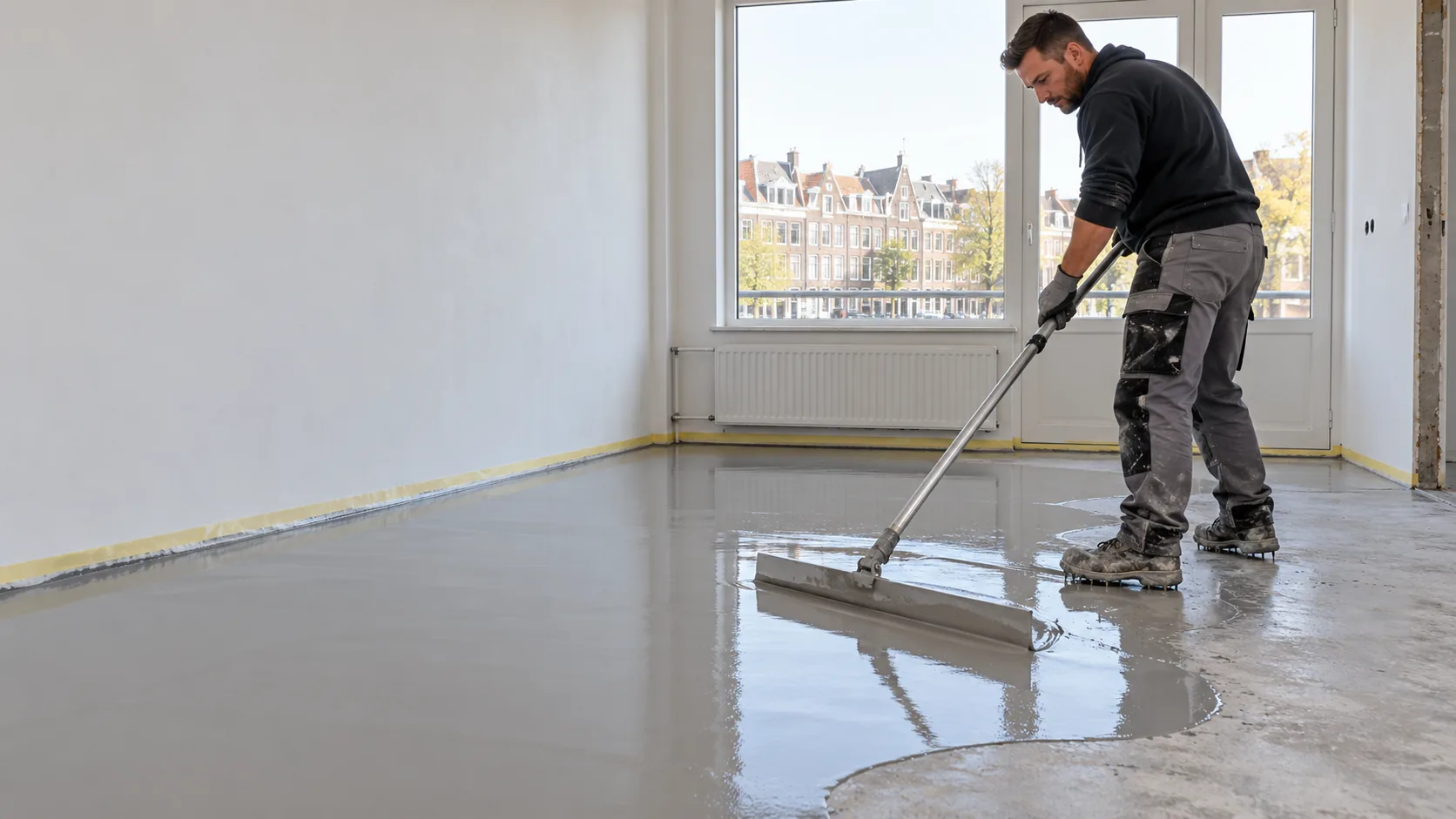
Floor levelling cost per m²: scope and examples
One floor specialist publishes a starting price of €16.34/m² including levelling compound and VAT, with a fixed quote after measuring. A separate public guide gives €15–€25/m² for levelling before PVC. The first figure is one provider's starting offer; the second is an indication for a particular use. Neither is a promise for a different contractor or surface.
| Work | Published example | Context |
|---|---|---|
| Levelling incl. compound and VAT | from €16.34/m² | Starting price after measuring |
| Levelling before PVC | €15–€25/m² | Indication for this use |
| Repair or special base | quote after inspection | Different scope |
At €15–€25/m², 30 m² works out to €450–€750 as an arithmetic example for that PVC preparation. A small job may have a minimum fee. Removing adhesive residue, repairs, extra thickness or a timber floor can change the scope significantly.
What would a larger levelling area mean for the budget?
The €15–€25/m² indication above applies to a defined PVC-preparation example, not to every floor. Multiplication makes the scale clearer; it does not turn the published indication into a contractor’s offer. The base, layer thickness and minimum charge still need checking.
| Measured area | Calculation using €15–€25/m² | What is missing |
|---|---|---|
| 30 m² | €450–€750 | Inspection, any repairs and the exact included items |
| 50 m² | €750–€1,250 | Thickness, primer and whether VAT is included |
| 70 m² | €1,050–€1,750 | Room layout, old adhesive and minimum charge |
For an honest comparison, ask each fitter to state the measured area, expected layer thickness and the final amount. If the old covering has not been removed, request a price for known work and a separate approval process for any hidden damage.
What should the levelling quote include?
The professional should inspect the existing base, clean it and apply an appropriate primer before placing the levelling layer. Ask whether the quote includes inspection, primer, compound, labour, VAT and a final flatness check. Published prices may include different combinations of these tasks.
Levelling is not a substitute for repairing a failing screed or a structural floor. Cracks, loose areas, moisture and old glue need their own assessment. Removing and disposing of old coverings may also be separate work.
A good quotation separates labour costs from the primer, levelling compound and any repair work. Ask whether the quoted price per square metre assumes a concrete floor or another substrate, the thickness of the layer and an agreed surface area. The amount of material changes with thicker layers. Product instructions, not a generic 25 kg bag rule, determine coverage and when the new covering can go down. If the surface is old tile or parquet, ask whether the proposed system is compatible rather than assuming the standard example applies. These checks explain why two similar per-m² prices can conceal very different preparation.
DIY levelling or a professional: what changes the cost?
Buying self-leveling compound and doing the work yourself may look cheaper than paying for material and labor. The comparison should include primer, tools, repair materials and the risk of an unsuitable substrate. A small sound concrete floor may be manageable if the product instructions cover that use. A moving wooden base, visible damp, deep cracks or a floor intended for glue-down PVC deserves an assessment before any leveling mortar is applied.
For a quote, ask who prepares the base, checks good adhesion and confirms it is ready for covering. The surface can be walkable before it is ready for a bonded finish. Underfloor heating, large height changes and old tiles can require a different system. A professional's price buys a defined scope and acceptance check; a DIY materials bill does not include those steps.
Do laminate and PVC always need levelling?
The answer depends on the existing surface and the chosen product. Glue-down PVC needs a surface suitable for bonding and visibly even finishing. Click PVC and laminate have different systems, but their manufacturers also specify how flat the base must be.
Do not order levelling by default or skip inspection because underlay can absorb small irregularities. Ask the installer which tolerance applies to the actual product and how the finished base will be checked.
Concrete, screed and timber floors
A sound cement-based screed with minor imperfections is a different job from a moving timber subfloor. Wood can require reinforcement, another primer or an alternative floor build-up. Severe damage or trapped moisture needs a suitable solution before a new coating is poured.
Layer thickness affects the volume of product and the height of the finished floor. Confirm clearances around doors and transitions to other rooms. Floor area alone cannot capture these details, so a site check is valuable.
Flat is not necessarily level
Levelling compound is used to make a base sufficiently even and suitable for a new covering. The finished surface may still follow a slight existing slope instead of being perfectly horizontal. Correcting a height difference between rooms can be a separate job needing more material and another quote.
Ask which tolerance the selected floor requires and what improvement will actually be delivered. Agree where heights are measured. This prevents 'levelling' meaning one thing to you and another to the person doing the work.
What about repairs or another layer?
A starting rate assumes a defined subfloor and thickness. A second layer, crack repair, old adhesive removal or a moisture barrier may be extra. Ask whether the contractor can give a fixed price after inspection and how any newly discovered work will be approved.
A per-m² rate is easier to apply to a large accessible room than to a tiny room with many obstacles. Ask for a full amount including VAT and any minimum fee. Do not turn an advertised rate into a promised quote by multiplying it by your room size.
A sensible sequence of work
The old surface is exposed and inspected first. Cleaning, any required repair, appropriate primer and the levelling layer follow. The next floor should only be fitted once the specified compound is suitably dry and ready. Exact steps depend on the materials and conditions on site.
Clarify who is responsible for inspection, priming, levelling and checking the result before flooring installation. If separate professionals handle these stages, an explicit handover helps avoid gaps in responsibility or price.
Drying time before the new floor
Drying depends on the product, layer thickness, temperature, humidity and the covering that will follow. Being safe to walk on does not necessarily mean the surface is ready for glue-down PVC. Follow the system's technical instructions and get a schedule from the professional.
Allow for this stage before booking the fitting date. Ask who checks the base immediately before the new floor is installed and what happens if the drying conditions delay the job.
How to request a useful quote
Send clear photos of the base, room dimensions, the intended floor type and any known cracks or damp patches. Say whether the base is concrete, screed or wood if you know. Ask which primer and thickness are assumed and whether old adhesive removal is included.
SkilledContractors is a marketplace for comparing professionals. A contractor can judge whether a published starting price is relevant only after looking at your floor. Compare the preparation, materials, acceptance criteria and final sum alongside the price per m².
Sources and scope
These technical sources support the guidance on subfloors and fitting. The fitting prices are separately recorded provider examples; the links below do not establish a market average or an individual quote.
Frequently asked questions
Answers to common questions.
What does levelling 30 m² cost?
At a published €15–€25/m² indication for PVC preparation, the arithmetic example is €450–€750. A contractor's actual quote depends on inspection and scope.
Are primer and levelling compound included?
One published starting tariff includes compound and VAT. Other quotes may differ, so ask separately about primer, material, labour and tax.
Does every PVC floor need levelling?
No. The condition of the existing base and the floor product's specifications determine which preparation is needed.
Can a timber floor be levelled like concrete?
Not automatically. Timber movement may require a different system or reinforcement; ask for an assessment.
When can the new floor be installed?
It depends on product, thickness and conditions. Use the manufacturer's instructions and confirm the installation date with the professional.
How much levelling compound does a room need?
Coverage depends on the chosen compound, subfloor and layer thickness. Use its technical data sheet and ask the contractor to state the expected thickness in the quotation.
Compare flooring quotes
Describe your floor, current subfloor and required finish. Compare offers for the same scope.