Practical guide
Creaking floor: causes, safe checks and professional assessment
A creaking timber or laminate floor needs the cause identified. Learn safe observations, warning signs and why sanding is not always the answer.
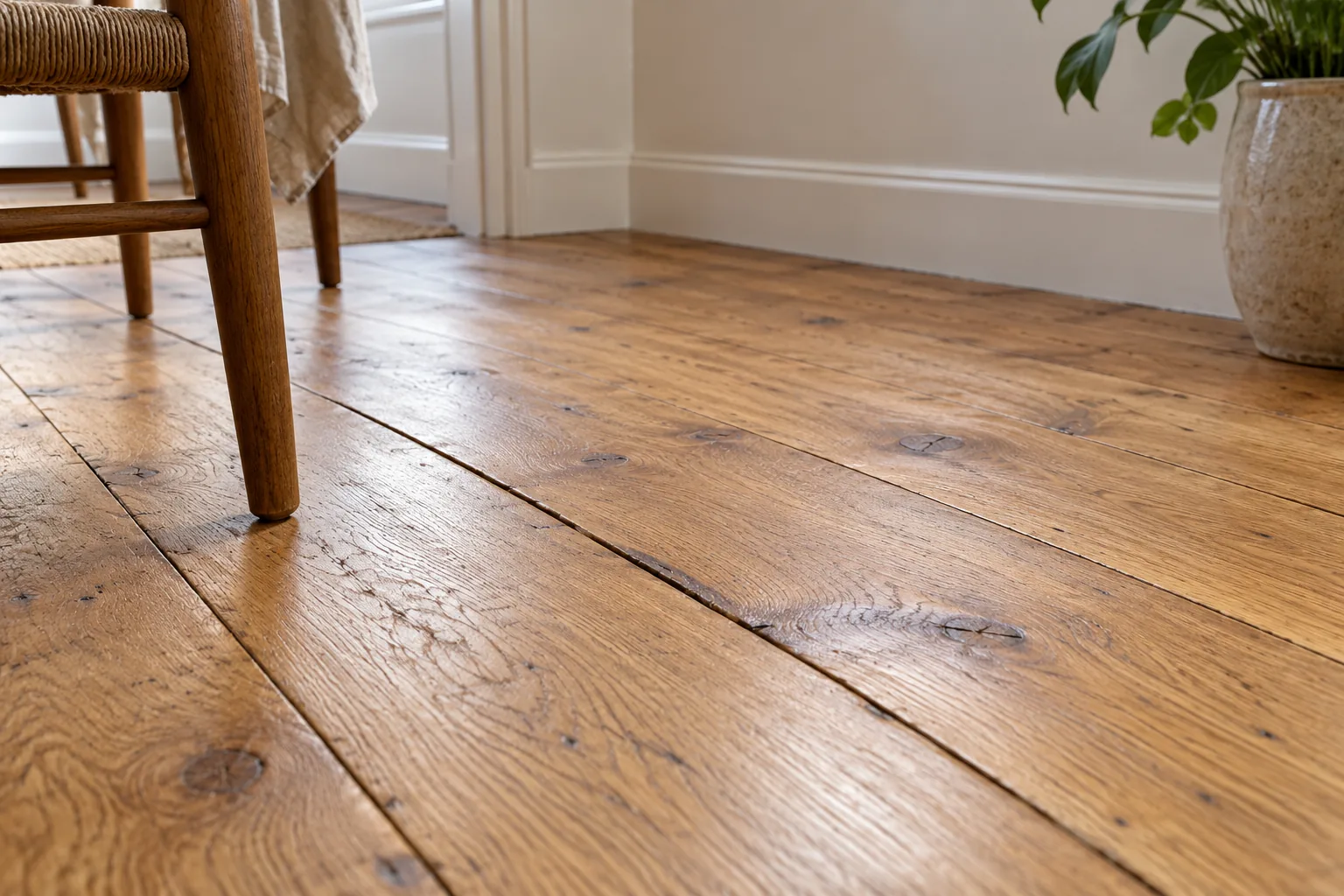
Quick answer: locate the sound and note any movement
A floor can creak because parts rub against one another, a fixing is loose or the base does not support the finish properly. Sound alone cannot establish which layer is responsible or whether the floor is safe. Note where the sound occurs and whether there is visible movement. Do not start by drilling or driving screws into an unknown floor build-up.
If creaking appears with sagging, significant new movement, damp or new cracks, avoid the affected area and arrange an appropriate professional assessment. A flooring finish and the structure beneath it require different kinds of repair.
Why might a timber floor creak?
Timber responds to changes in moisture and temperature. Movement between boards or around a fixing can produce noise. Parketfabriek Lieverdink’s guidance explains the relevance of indoor humidity to wooden flooring; that does not mean every creak is caused by a dry room.
The finish, subfloor panels and supporting joists are separate layers. A loose visible board is a different problem from a defect in the supporting structure. Tell the professional whether the sound began recently, follows a leak or changes with the heating season. Do not treat sanding as a remedy for a loose connection below the finish.
Creaking laminate or another floating floor
A floating floor needs suitable support and the movement space required by its product. A restricted edge, doorway or transition may be relevant. The specified underlay also matters; adding a softer layer is not automatically an improvement.
Quick-Step’s installation guidance describes preparation of a suitable base. It helps establish what should have been checked, but it does not diagnose your floor from a sound recording. The instructions for the actual brand and model remain the reference. Screwing down a floating finish can interfere with its movement and is not a general solution.
What can you safely observe?
- Walk gently only where the floor feels firm; do not jump or add weight as a test.
- Note whether the noise is in one place, several rooms or around an edge.
- Record visible changes in joints or transitions.
- Look for accessible water marks or a known recent leak.
- Make a short recording and keep the flooring and installation details.
A hygrometer can help record the room’s changing conditions, but a reading does not prove the cause of a defect. Compare conditions with the product guidance rather than immediately buying a humidifier or dehumidifier to treat an unexplained sound.
You do not need to remove fixed skirting, lift boards or enter a confined crawl space for these initial observations. If you suspect an edge is trapped, describe it without pulling the floor apart.
When to stop trying a repair yourself
Stop if the area sags, movement changes suddenly, new cracks appear or timber seems soft. Arrange an assessment before continuing to use or work on the affected area. Do not use the noise alone to decide that a structural problem is harmless.
Do not drill or screw before the floor construction and positions of pipes, cables and underfloor heating are known. Powders, oil, glue and fillers can stain the finish or complicate repair. They do not make a weak structure safe. Use a treatment only when it is appropriate for the identified system and defect.
What should a professional investigate?
The first question is which layer moves. On a timber board floor, the assessment may concern fixings and support. With a floating finish, it may concern the base, joints, edge clearances or transitions. Subfloor panels can also move at their connections. These are reasons to investigate, rather than a universal repair sequence.
Ask the professional to distinguish the cause from the visible finish and explain how it will be checked. Find out whether local repair is possible, what must be opened and how damage to the surface will be limited. If more extensive work is proposed, ask why the symptoms require it.
Repair, sanding or replacement?
These solve different problems. Sanding treats the surface of suitable timber; it does not repair a loose supporting connection and is not suitable for every wear layer. The remaining thickness and previous treatments need checking before sanding is chosen.
A local repair may suit one affected connection. Similar sounds in several rooms may have a shared cause that needs assessment first. Installing a new finish over an unresolved moving base can leave the original problem in place.
Use flooring services to describe a creaking or moving floor as an investigation, rather than ordering a new floor by default. The floor installation cost guide helps separate installation and preparation costs; it is not a quotation for structural repair. For a raised laminate floor, see laminate flooring lifting.
Looking after the floor after repair
Follow the flooring system’s installation and care guidance. Have the base and underlay assessed before replacing a finish, report new sounds after recent work and keep a record of when they started. Do not wet a floor to make it swell or fasten a floating finish to silence it. A clear explanation of the defect and the agreed repair provides a better starting point for follow-up than a general promise that all noise will disappear.
Sources
Related content
Describe your flooring problem
Include the flooring type, where the defect is and when it began. Ask for the cause to be assessed.
Find flooring servicesFrequently asked questions
Answers to common questions.
Is a creaking floor always dangerous?
No, but sound alone cannot establish safety. Sagging, significant new movement, moisture or new cracks need professional assessment.
Can sanding stop a floor creaking?
Sanding changes a suitable timber surface. It does not repair a moving base or loose supporting connection.
Should I screw down a noisy floating floor?
Do not do so without assessment. Fastening a floating finish can interfere with its movement, and concealed services need locating before drilling.
Why did my timber floor start creaking suddenly?
Changing conditions can matter, but loose fixings or damage may also be relevant. Record what changed and arrange assessment if movement or damp appears.