Practical guide
Laminate flooring lifting or buckling: causes and next steps
Raised laminate needs assessment of movement space, moisture and support. Learn what to observe and when to contact a fitter.
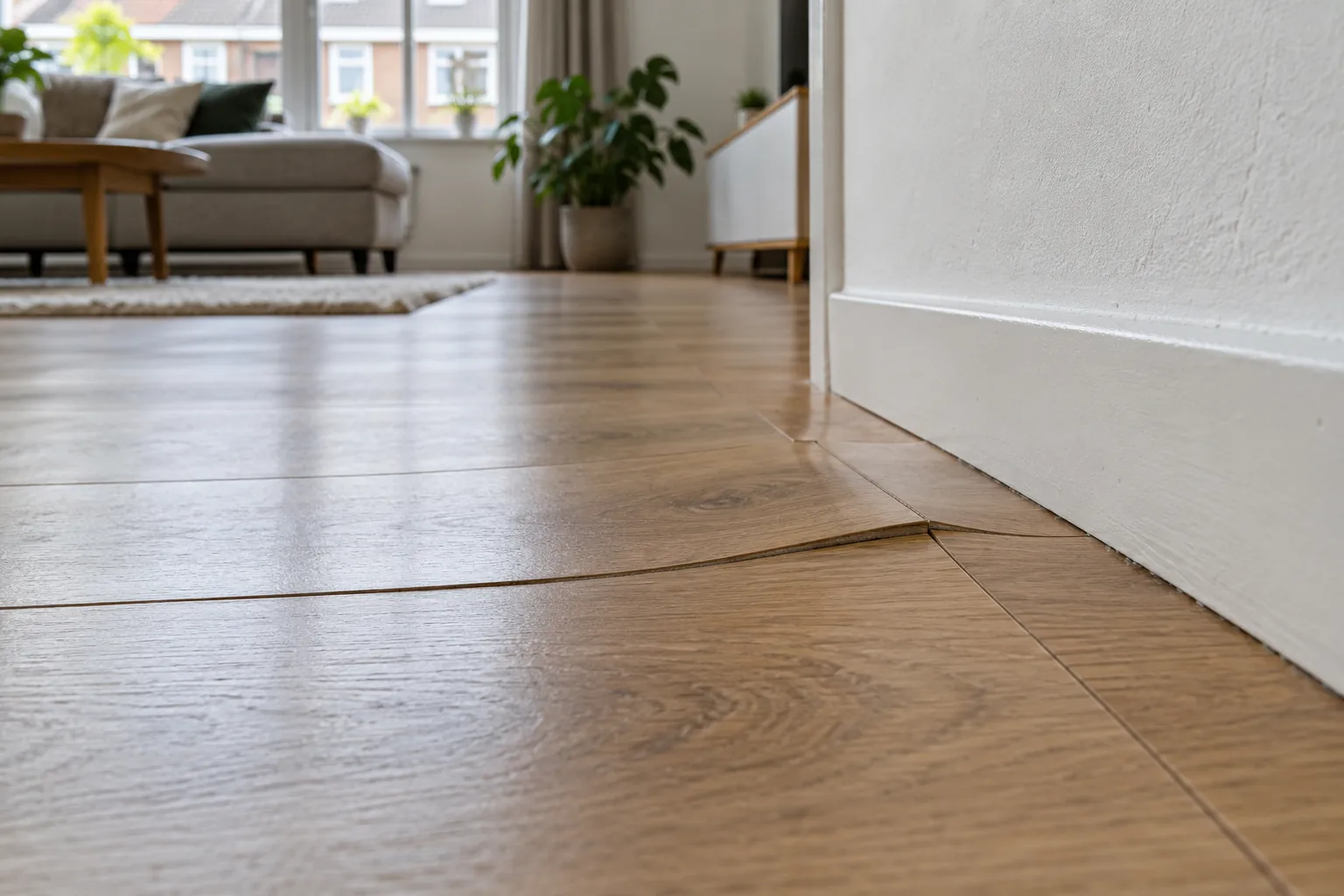
Quick answer: check moisture and restricted movement first
Laminate can lift when a floating floor cannot move freely, when moisture affects the boards, or when the base or joints do not support it properly. The shape of a raised area helps describe the problem, but does not establish its cause. Do not flatten it with heavy furniture or immediately cut along the wall. Keep a raised edge out of the walking route and contact the original fitter if the floor was recently installed.
If there is an active leak, deal with the water source first where it is safe to do so. Remove accessible surface water without using electrical equipment in a wet area. A dry-looking surface does not prove that the underlay or base is dry.
A broad hump or swollen board edges?
| What you can see | What needs checking |
|---|---|
| A broad raised area with relatively intact boards | Movement space at walls, doorways and fixed objects |
| Thickened, rough or distorted plank edges | Moisture damage and the condition of affected boards |
| A local bump or movement underfoot | Support from the base, underlay and joints |
| Lifting after a leak or wet cleaning | Water source, moisture below the floor and damaged parts |
Photograph the whole area and the individual joints. Note whether the problem is beside a kitchen unit, doorway, radiator or external wall. Creaking or springiness can occur alongside lifting, but those symptoms are not interchangeable. Describe each separately.
Why a laminate floor can rise
The floating floor is trapped
A floating floor needs the movement space specified for its product and room layout. A tight doorway, unsuitable transition or fixed object can restrict it. Skirting should finish the edge without pinning the floating boards down. The required gaps and treatment of large connected areas depend on the installation instructions; one universal gap measurement is not suitable for every floor.
Quick-Step’s repair guidance identifies moisture changes and insufficient expansion space as possible causes of lifting. That gives the fitter useful questions to investigate. It does not prove that cutting back one edge will solve your particular problem. Moisture and restricted movement can also occur together.
Moisture affects the boards or base
A leaking pipe, water entering at a doorway or excessive water during cleaning can be relevant. Swollen board edges may remain damaged after the room dries. Ventilation cannot fix a continuing leak, and a moisture reading taken only at the surface cannot fully assess a concealed substrate.
Tell the fitter when the first change appeared, whether water was present and what has already been cleaned or dried. Keep the product name and purchase information. Water-resistance claims apply to particular products and conditions, rather than to every part of the floor build-up.
The base, underlay or joints need assessment
Uneven support or a damaged click connection can produce a raised or unsettled area that resembles expansion-related lifting. Adding a soft layer or gluing joints does not establish which part is failing. The fitter should assess the base and the specified underlay together.
If the floor has underfloor heating, provide the floor and heating instructions and describe any recent changes in settings. Do not turn up the heating to force an unknown moisture problem to dry.
Safe observations before the appointment
- Note when lifting began and whether the area is growing.
- Photograph the room and the raised joints without pressing them down.
- Look for visible water marks or a known recent leak.
- Record whether a doorway, threshold or fixed unit appears to restrict the edge.
- Find the flooring model, installation date and underlay details.
- Report the defect to the original installer or supplier before attempting a repair.
You do not need to remove skirting or lift boards to provide this information. Do not test the floor by adding water, jumping on it or putting a heavy weight on the hump. Avoid directing hot air at a board or sealing a wet edge with silicone; those steps can obscure the problem without removing its cause.
Repair or replace the laminate?
The answer depends on the cause and the condition of the boards. A fitter may be able to release a restriction or repair a local section. Swollen edges, damaged joints or moisture beneath the floor can require other work first. Replacing the visible boards while leaving the underlying cause unresolved can lead to the same problem returning.
Ask for a written distinction between investigation, fixing the cause and replacing the finish. Find out whether existing boards can be reused and how the repair will join the rest of the room. A complete new floor is not automatically the first step.
When to arrange professional help
Arrange assessment if the lifting increases, boards are damaged, the walking route is unsafe or the cause is unclear. Sagging, significant movement or signs of a problem in the supporting structure call for an appropriate specialist assessment rather than routine laminate fitting.
For fitting or replacement work, see laminate flooring installation. The laminate installation cost guide explains how to compare fitting, boards, preparation and finishing; its fitting examples are not a repair quotation. For an unclear flooring problem, start with flooring services.
Reducing the chance of a repeat problem
Follow the specific floor’s cleaning and installation instructions. Have leaks investigated, preserve the product details and discuss changes to fixed furniture, thresholds or skirting before they restrict an existing floating floor. Ask the fitter what must be checked before the repaired area can be used again. These practical agreements are more useful than treating every raised board as the same defect.
Sources
- Quick-Step — repairing lifting laminate (Dutch) (2026-10-20)
- Quick-Step — laminate finishing (Dutch) (2026-10-20)
- Quick-Step — laminate installation (Dutch) (2026-10-20)
- Quick-Step — preventing moisture problems (Dutch) (2026-10-20)
Related content
Describe your flooring problem
Include the flooring type, where the defect is and when it began. Ask for the cause to be assessed.
Find flooring servicesFrequently asked questions
Answers to common questions.
Will a lifted laminate floor settle by itself?
That is not certain. Restricted movement and moisture damage require different responses. Have the cause assessed before replacing or cutting boards.
Can I press the hump down with furniture?
No. Weight does not resolve the cause and may cause more damage. Keep the raised area out of the walking route.
How much space should be left at the wall?
Use the requirements for the actual product and room layout. One gap measurement is not suitable for every flooring system.
Is fitting a new floor always necessary?
No. The condition of the boards, joints and base determines whether local repair or replacement is appropriate.