Practical guide
PVC flooring coming loose: identify the problem before repair
Distinguish loose glue-down strips, opening click joints and surface damage. Learn what to record before a professional assessment.
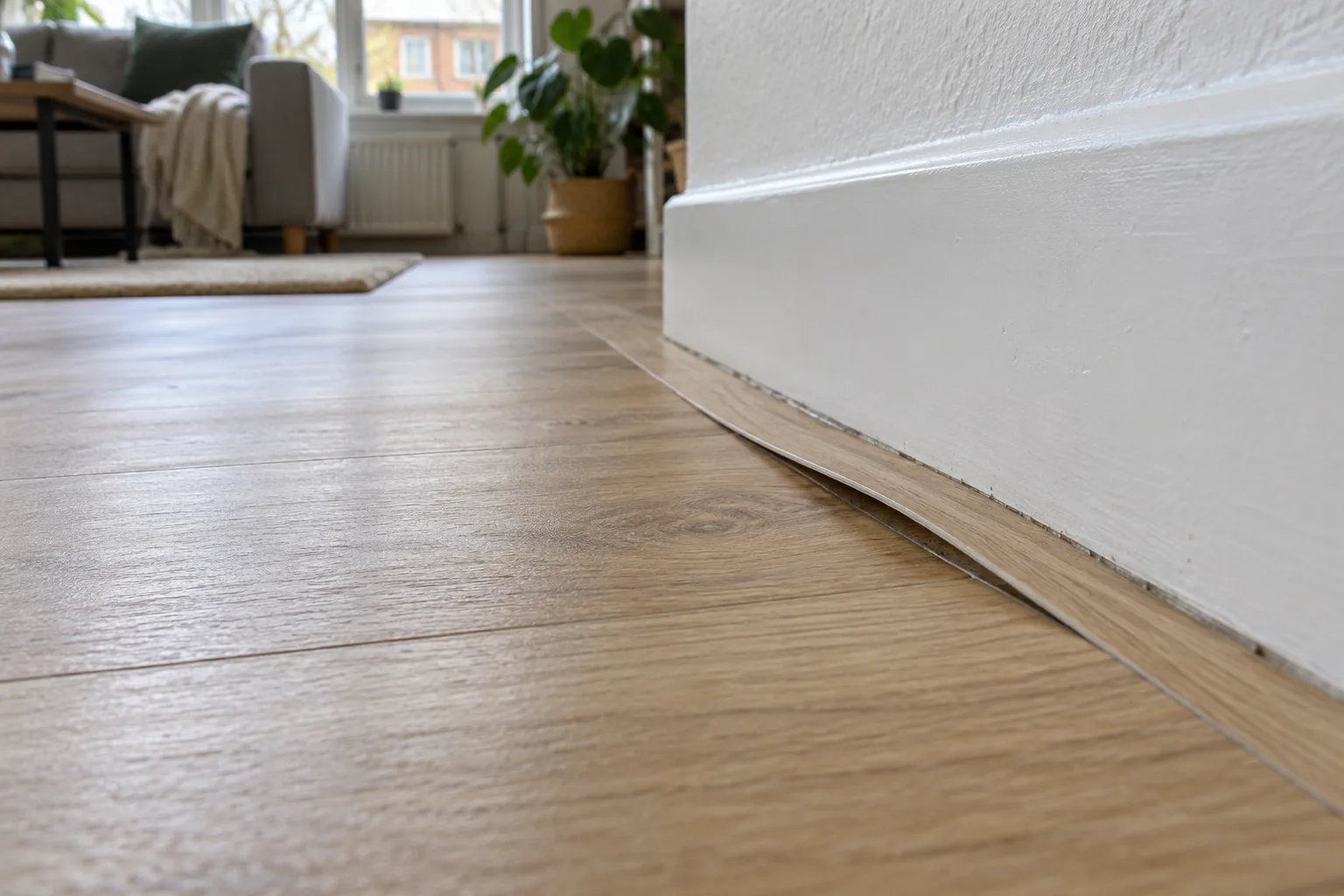
Quick answer: identify which layer is coming loose
A loose PVC floor can mean a glue-down strip is separating from its base, a click joint is opening, or the wear layer itself is damaged. These require different assessments. Do not inject adhesive under an edge before the system, substrate and possible moisture problem have been checked. Keep a raised edge out of the walking route and report it to the fitter.
If you can see an active leak, address the water source first where it is safe to do so. New adhesive or another strip cannot solve continuing moisture beneath the floor.
Glue-down PVC, click PVC or surface damage?
| Symptom | Question for the assessment |
|---|---|
| A thin bonded strip lifts from the base | Is the failure in the adhesive, preparation layer or substrate? |
| A click joint opens or an edge rises | Are the connection, movement space and support suitable? |
| Only the top surface peels or tears | Is this product or surface damage rather than a bonding problem? |
Look for the product name in the invoice or installation information. In the Netherlands, PVC flooring can refer to several vinyl systems. A repair intended for a bonded strip should not be applied to a floating click floor. Laminate is another product again.
Photograph both the defect and the surrounding area. Do not pull up more strips to see how far the problem extends. If you cannot identify the flooring system, let the professional establish it before recommending a repair.
What can cause the floor to loosen?
The substrate or preparation layer
A glue-down system needs a suitable base and compatible preparation products. Dust, an unstable layer, unsuitable surface preparation or a weak levelling layer may be relevant. Floer’s explanation of loose PVC highlights the importance of the substrate and installation system. A loose corner alone does not show which layer has failed.
Ask whether the screed, primer and levelling layer are still sound, rather than assuming the strip simply needs more glue. An area that was levelled before installation is not automatically dry, stable or suitable today. A click floor also needs adequate support, but an extra underlay should only be used where the chosen system permits it.
Moisture below the finish
A PVC product may tolerate water under specified conditions, while the adhesive, levelling compound and substrate have different requirements. Surface water resistance does not establish that the whole build-up is unaffected by a leak.
Tell the professional about recent water, damp patches or changes near the defect. Appropriate moisture investigation may be needed before repair. The method must suit the substrate; a quick reading at the top surface is not a complete diagnosis of the layers below.
Adhesive, processing and temperature
The adhesive, substrate and floor product must form a compatible system. Product instructions govern preparation and use. Do not add an unfamiliar adhesive, solvent or filler yourself, because that can make later assessment and repair harder.
Direct sunlight, heating and recent temperature changes can be useful information for the installer. Follow the instructions for the actual product and heating system. Do not increase underfloor heating to influence damp or adhesive, and do not use a general maximum temperature or drying time without checking that it applies.
Safe information to collect
- Record when the edge first loosened and whether it is spreading.
- Note any leak, water mark or intense sunlight nearby.
- Find the flooring model, installation date and installer’s details.
- Take overview photographs and close-ups without bending the strip further.
- Explain whether the problem is one strip, several areas or a click seam.
Avoid inserting a knife or screwdriver beneath the finish. Pulling up other strips or repeatedly bending a raised edge can damage material that might otherwise be reusable. Keep the product and installation records available for the original fitter.
Local repair or laying the floor again?
Local repair may be possible when the cause is known, the base is suitable and the surrounding floor remains sound. Several loose strips, moisture or a separating preparation layer may need more investigation before a repair is chosen. A raised corner is not by itself a reason to replace the whole floor.
Ask what has failed, how the cause will be addressed and which products are compatible with the existing system. Agree which material can be reused and when the area may be walked on or furnished again. The timing should follow the specified system, rather than a general promise of immediate use.
For replacement or installation work, see PVC floor installation. For an unclear repair problem, use flooring services and describe it as an investigation. The PVC installation cost guide provides context for fitting and preparation, not a price for diagnosing your defect.
Preventing a repeat defect
Keep the floor, adhesive or underlay information and follow the manufacturer’s maintenance instructions. Report leaks promptly and consult the original fitter about new movement, loose edges or changes after recent work. For a floating click system, fixed items and edge details must follow the installation guidance. Finding and resolving the cause is more useful than repeatedly fixing the visible edge.
Sources
- Floer — why PVC flooring comes loose (Dutch) (2026-10-20)
- Quick-Step — PVC installation (Dutch) (2026-10-20)
Related content
Describe your flooring problem
Include the flooring type, where the defect is and when it began. Ask for the cause to be assessed.
Find flooring servicesFrequently asked questions
Answers to common questions.
Can I glue a loose PVC strip back myself?
Have the system and cause assessed first. Unfamiliar adhesive can complicate investigation and later repair.
Does water-resistant PVC rule out moisture damage?
No. Adhesive, preparation layers and the substrate have their own requirements. A dry surface does not establish that the layers below are dry.
Does a loose strip mean the whole floor needs replacing?
Not automatically. Local repair may be possible if the cause is understood and the base and surrounding floor are suitable.
Is an opening click joint an adhesive problem?
Not necessarily. Click flooring has different connections and support requirements from bonded PVC.