Bathroom Demolition Cost in the Netherlands: 2026 Guide
Bathroom demolition in the Netherlands often costs €500 to €1,500 for a professional strip-out. A small, simple job may cost less. Heavy tiles, floor screed, poor access, extra waste, or asbestos can raise the total. Check whether protection, carrying, transport, disposal, and VAT are included.

By Arek
Updated September 28, 2026 · 11 min read
Average bathroom demolition costs and scope
The total cost depends on the work scope. Removing loose fixtures is not the same as a full strip-out. A full bathroom demo may include tiles, screed, ceilings, and pipes.
| Work scope | Typical market range | What the price may cover |
|---|---|---|
| Published room-size estimate | €265–€685 | One Dutch guide's bands from small through large rooms |
| Professional bathroom strip-out | €500–€1,500 | Fixtures, sanitary ware, tiles, and waste, depending on scope |
| Complex or specialist scope | Above €1,500 | Thick finishes, floor layers, ceilings, difficult access, or extra labour |
These are market guide prices, not SkilledContractors prices. Published contractor ranges differ in scope. Some include waste and VAT. Others charge those items separately. Compare each quote line by line.
This cost information comes from published Dutch cost data. It compares the cost of removing old finishes. It does not price the complete bathroom renovation.
Do not add every table maximum together. Several items may already sit inside a fixed strip-out price. Actual costs may vary when the scope changes. The actual cost should follow the written scope.
Bathroom demo costs: a price breakdown
The table below helps you test a quote. It also shows where additional costs can arise.
| Cost item | Typical market range | Important scope note |
|---|---|---|
| Strip-out worker | €30–€60 per hour | Hourly rates may exclude VAT, travel, and waste |
| Remove wall tiles | €20–€40 per m² | Depends on the adhesive, wall, and access |
| Remove floor tiles | €25–€50 per m² | Floor protection and debris may cost extra |
| Remove cement screed | €35–€65 per m² | Deeper work creates more weight and waste |
| Remove concrete floor | €75–€150 per m² | Structural checks and specialist tools may be needed |
| 6–10 m³ waste container | About €400–€500 | Waste type, location, hire period, and permit can change the price |
| Asbestos inventory | About €300–€1,200 | Separate specialist service when asbestos may be present |
| Small-room asbestos removal example | About €2,000–€2,500 | Separate remediation market range, not normal strip-out work |
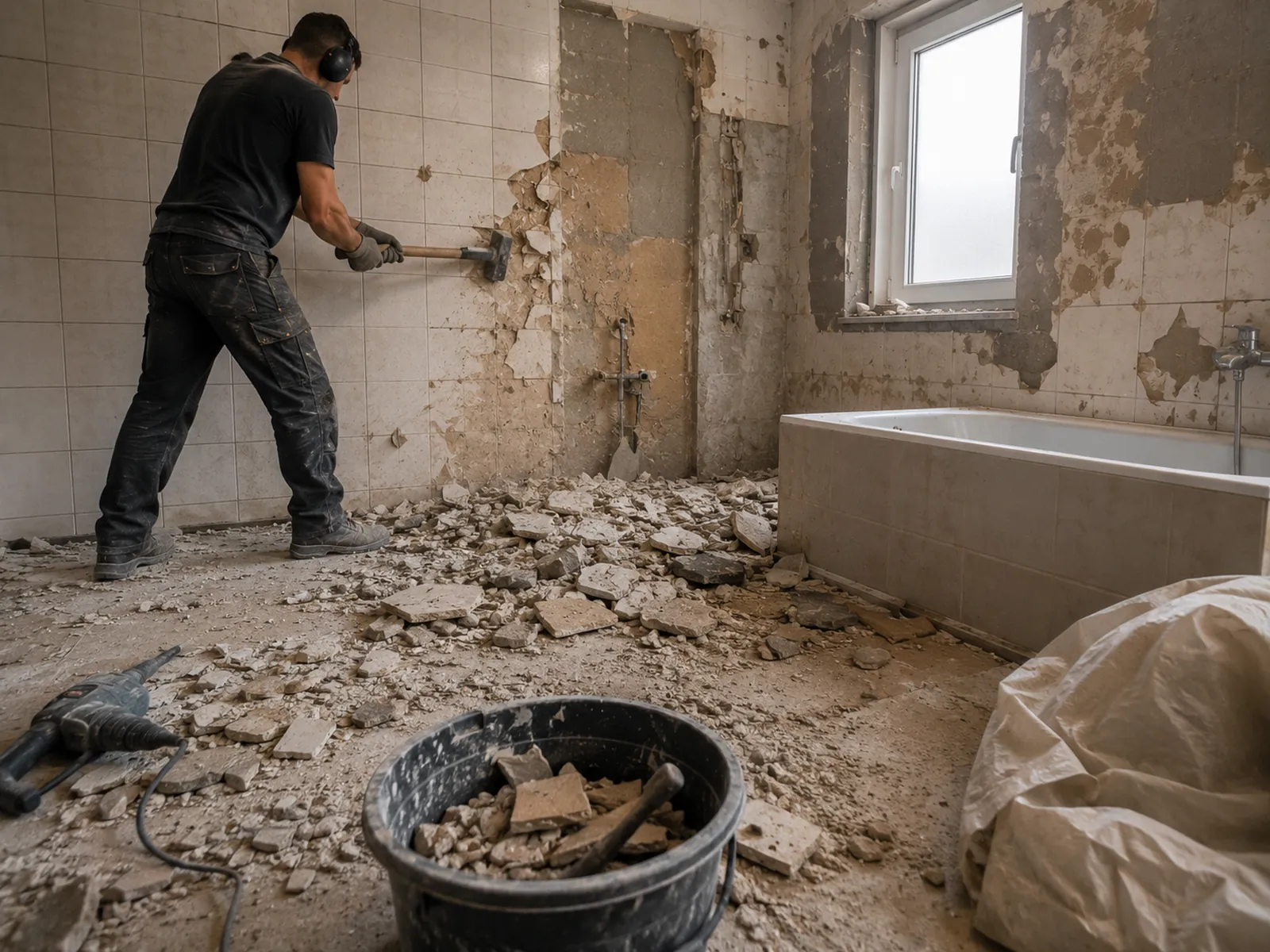
The tile removal cost can dominate a fully tiled room. Mortar beds and hard screed take longer to break. They also create heavy debris. A concrete floor needs more care than loose flooring.
An hourly rate can help with a partial demo. A fixed price is often clearer for a full bathroom strip-out. Ask for the assumptions behind either price.
What does a bathroom strip-out include?
A complete scope should state every surface and fixture. The words “bathroom removal” are too broad on their own. Common bathroom fixtures may need different tools and care.
A professional quote may include:
- protecting the route through the home;
- isolating agreed water or electrical points;
- removing the toilet, vanity, bath, or shower enclosure;
- taking off wall tiles and floor tiles;
- removing selected flooring, screed, wallboard, or ceiling layers;
- sorting, carrying, loading, and transporting debris;
- container hire and lawful disposal;
- a swept, safe room for the next trade.
Confirm whether taps, radiators, mirrors, cabinets, and doors stay. Also mark any fixture that you want to reuse. Salvage must be agreed before work starts because careful dismantling takes longer.
The demolition contractor should not guess where the next fittings will go. Plumbing and electrical changes belong in the rebuild plan. Compare local plumber costs and electrician costs separately.
Low strip-out prices can reflect a narrow scope. Common exclusions include:
- disconnecting or moving live pipes and cables;
- hidden layers behind tiles;
- concrete, thick screed, or reinforced surfaces;
- asbestos inspection and specialist work;
- parking, lift protection, or a street permit;
- container hire, transport, or disposal fees;
- repairing walls and floors after the strip-out;
- new plumbing, wiring, waterproofing, and installation;
- VAT.
Ask whether the contractor allows for one finish layer or all layers. Hidden layers are a major cost risk in older bathrooms.
Fresh plaster or waterproof wall finishes are rebuild work. They are not part of the strip-out. Use the bathroom plastering cost guide for that stage.
Bathroom demolition cost factors
Bathroom size and strip-out depth
A larger bathroom usually has more tile, fixtures, and debris. Yet size is not the only driver. A small bathroom with hard mortar can cost more than a larger, simple room.
Partial demolition removes selected fixtures or finishes. A full demo clears most non-structural parts of the room. Define which walls, floors, and ceilings are included.
Foreign cost data may group rooms as a half bathroom, primary bathroom, or large bathroom. Those labels are less useful in a Dutch quote. Give the actual size and bathroom fixtures instead.
Some cost estimates use a rate per square foot. Dutch trades usually use square metres or a fixed scope. A foreign cost calculator cannot see hidden Dutch building layers.
Tile, mortar, and floor construction
Bathroom tile can hide several old layers. Wall and floor tile may use different adhesive. Thick mortar and cement screed add labour. Concrete breaking also adds noise, dust, and heavy waste.
Do not assume that a square-metre rate covers every layer. Ask for a price per layer when the construction is uncertain.
Plumbing and electrical services
Old pipes or cables may run close to the surface. Their position may not match the drawings. Damage can stop the project and add repair work.
The quote should say who isolates each service. A qualified trade may be needed. Never treat live services as ordinary waste.
Access and protection
Upper floors, narrow stairs, and long carrying routes add time. Apartments may need lift protection or set working hours. A container may also need to stand farther away.
Poor access can increase the cost significantly. State the floor, lift access, and carrying distance.
Dust barriers and floor covers protect the rest of the home. They cost money, but they reduce avoidable damage. Protection should be a named quote item.
Waste volume and weight
Tiles, mortar, and concrete are dense. A container can reach its weight limit before it looks full. Mixed waste may also cost more than sorted waste.
A full bathroom renovation often creates about 3–6 m³ of debris. The exact volume depends on the room and removed layers. Ask the provider to confirm accepted materials and weight limits.
Three useful budget scenarios
These examples show scope differences. They are not fixed offers.
1. Selective fixture removal
The toilet, vanity, and shower screen are removed. Most tiles and floor layers stay. Access is easy, and waste is limited.
This may sit below the average cost to remove an old bathroom. The quote should still cover disconnection, carrying, and disposal.
2. Standard bathroom strip-out
Sanitary fixtures and most tiles are removed. The contractor protects the route and clears the debris. Published Dutch market guides often place this work near €500–€1,500.
Check the tile area and floor depth. Those details explain wide price differences.
3. Complex strip-out
The room has thick screed, a concrete layer, or hidden services. Access is poor, and debris must travel far. The total can exceed €1,500 before specialist asbestos work.
How to reduce bathroom demo costs
Good planning can reduce bathroom demo costs without hiding work. Send the same scope to each provider. Include the room size, tile areas, carrying route, and photos.
Decide what stays before the visit. Late changes can impact the cost. Ask whether sorted waste lowers the overall cost. It may not help when extra handling cancels the saving.
Contractors often offer a fixed price for a defined strip-out. They may charge by the hour for uncertain or partial work. Compare the final total, not one rate.
If you are renovating your bathroom, align the strip-out with the rebuild plan. This avoids taking out a sound layer that the next trade could use. It also stops duplicated plumbing and electrical work.
Hire a professional or do the demo work yourself?
DIY can reduce labour costs. It can also transfer risk to the homeowner. You still pay for tools, protection, transport, and disposal.
Loose furniture may be simple to remove. Tile, screed, pipes, wiring, and asbestos need more judgement. Stop if you find unknown boards, insulation, adhesive, or pipe lagging.
The cost to hire professional demolition services can be worthwhile. Professionals know how to safely remove many fixed items. Hire qualified specialists for live services or suspect materials.
Professional help is sensible when:
- the bathroom is in an occupied home or apartment;
- pipes and cables are hidden;
- floor or wall construction is unclear;
- heavy material must cross shared areas;
- a structural element could be affected;
- asbestos may be present.
DIY savings disappear after costly damage. Compare risk, not just the hourly rate.
Bathroom demo costs for waste and transport
Waste handling has four parts: carrying, loading, transport, and processing. A quote may bundle them. Another provider may only leave debris at the door. Ask who will dispose of each waste type.
A 3 m³ container may suit a small strip-out. A 6 m³ container is more common when walls, ceilings, or floor layers go. Container sizes are estimates, not guarantees.
Ask these questions before booking:
- Which waste types are allowed?
- Is there a weight limit?
- How long is container hire included?
- Are delivery and collection included?
- Who arranges any street permission?
- Is waiting time charged?
A cheap container can have costly exclusions. Keep asbestos and other restricted waste out of normal building waste.
VAT, demolition notification, and asbestos
VAT on strip-out work
This work normally falls under the Dutch 21% VAT rate. The reduced 9% rate only applies to named work on eligible homes. The Belastingdienst rules cover services such as painting, plastering, and insulation. They do not list normal demolition.
Mixed projects may need separate VAT lines. Ask whether each quote is inclusive or exclusive of VAT.
Demolition notification and a street container
Under the national rules, a demolition notification is generally required above 10 m³ of demolition waste. Lower volumes can still trigger rules when asbestos is involved. Read the IPLO demolition notification guidance and use the Omgevingsloket check for the project address.
A container on public land may need a local notice or permit. Rules and fees differ by municipality. Check them before setting a delivery date.
Asbestos risk in an older bathroom
Homes built before 1994 need extra care. Asbestos may occur in boards, vinyl backing, adhesives, pipe insulation, or other products. Appearance alone cannot confirm it.
An asbestos inventory is required where asbestos is known or reasonably suspected. IPLO explains the asbestos inventory duty. Limited private removal exceptions exist, but strict conditions apply. Do not break or drill suspect material.
Specialist inspection and remediation sit outside the normal strip-out price. Put them on separate quote lines.
Preparing the room for the next stage
Demolition work should support the rebuild plan. Keep reference points for drains, supply pipes, and cables. Record hidden services before new finishes cover them.
The next quote may include plumbing, electrical work, wall repair, waterproofing, tiling, and fixture installation. Those are installation costs, not strip-out costs. A plumber will plumb and test new fittings during that later stage.
For complete project support, review the bathroom renovation service and the wider renovation service.
Ready to compare a defined scope? Post the bathroom job with photos and measurements.
Frequently asked questions
Answers to common questions.
How much does it cost to demo a bathroom?
A professional bathroom strip-out often costs €500–€1,500 in Dutch market guides. The average cost to demo a simple room can be lower. Depending on the size and floor, you may expect to pay more.
Is bathroom removal the same as a bathroom strip-out?
The terms often share the same search intent. Their scope can differ in quotes. Bathroom removal may mean fixtures only. A strip-out usually includes more finishes and debris.
How long does a bathroom strip-out take?
There is no reliable standard time. Size, tile layers, access, services, and waste handling all matter. Ask for a schedule based on an inspected scope.
Can I demolish a bathroom myself?
You can remove some loose items if services are safely isolated. Do not disturb unknown material, live services, or structural parts. Specialist rules apply to asbestos.
Does a demolition quote include waste disposal?
Not always. Confirm carrying, loading, container hire, transport, processing fees, and VAT. Ask which materials are excluded.
What size container is needed for a bathroom demo?
A full renovation often creates 3–6 m³ of debris. A 3 m³ container may suit a small room. More layers may need 6 m³ or more.
Do I need permission to demolish a bathroom?
Normal internal strip-out may not need a permit. A notification may apply above 10 m³ or when asbestos is involved. Structural changes and public-space containers can trigger other rules. Check the address in Omgevingsloket.
Is asbestos work included in the strip-out price?
Usually not. Inspection, analysis, notification, and asbestos removal are specialist services. Request separate prices when asbestos may be present.
How to compare strip-out quotes
Give every contractor the same scope. That makes price differences useful. The total demolition cost must include every agreed task. Use this checklist: room dimensions and clear photos;, a list of fixtures to remove or keep;, wall and floor areas in square metres;, known finish layers and floor construction;, service isolation responsibilities;, protection for floors, stairs, lifts, and doors;, carrying route and parking limits;, container size, weight, and accepted waste;, transport and disposal receipts if relevant;, exclusions for hidden work;, start condition and handover condition;, VAT status and total price. The clearest quote defines the final room condition. “Empty” can mean bare walls, bare structure, or only removed fixtures.