Spray Plastering Cost: 2026 Price Guide for the Netherlands
The spray plastering cost in the Netherlands is often €6 to €15 per m² for standard indoor spack spray work. White spack often costs €6 to €10 per m². A colour or added texture may cost €8 to €15 per m². Small jobs often start at €290 to €400 because setup, masking and machine cleaning still apply.

By Arek
Updated August 5, 2026 · 25 min read
How much does spray plastering cost in the Netherlands?
Most spray work is priced by square metre. The rate is lowest on a large, empty and sound surface. A small or occupied room can cost more per metre because fixed setup time is spread over less area.
| Spray plaster work | Indicative Dutch price |
|---|---|
| White spack spray plaster | €6–€10 per m² |
| Coloured spack finish | €8–€13 per m² |
| Fine or heavier texture | €8–€15 per m² |
| Smooth thin spray plaster | €8–€15 per m² |
| Spack on a ceiling | €8–€15 per m² |
| Primer when priced separately | €3–€7 per m² |
| Extra levelling | €12–€20 per m² |
| Masking when priced separately | €1.50–€2.50 per m² |
| Plasterer hourly rate | €45–€65 per hour |
| Small-job or start rate | €290–€400 total |
These ranges often cover labour and the sprayed product. They do not always include broad repairs, thick levelling, full masking, travel or VAT. A written scope should name each included item.
Quick price by finish
White spack is often the lowest-cost choice. Colour adds pigment and may add €2 to €3 per m². A finer or stronger grain can also raise the rate. Smooth airless work needs another product and a much flatter base.
The final rate can sit above €15 per m² when prep is heavy. At that point, compare a spray method with normal hand plaster. The wall plastering cost guide explains standard indoor wall rates.
Why can spray work cost less?
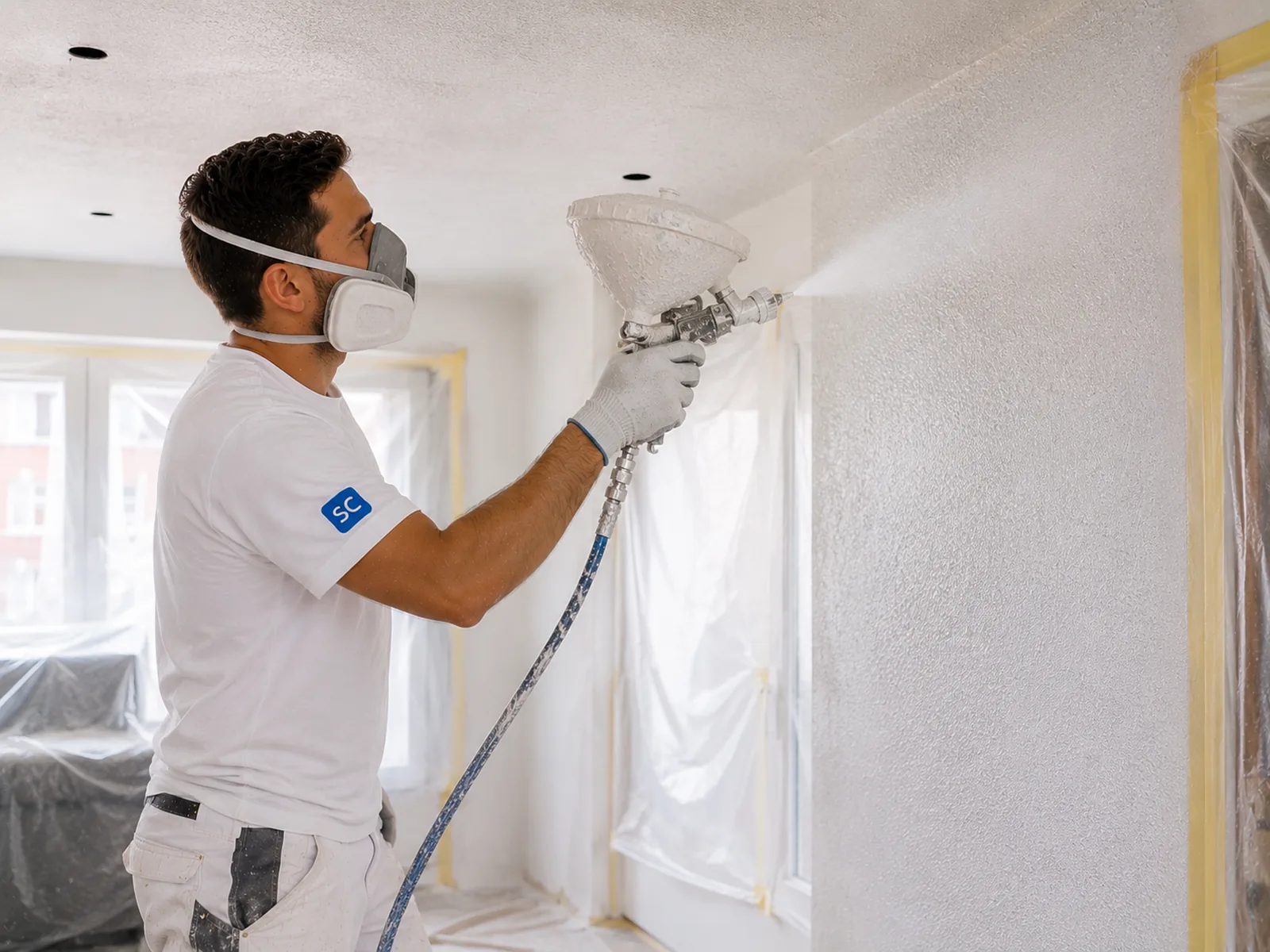
A spray machine pumps product across a broad surface. This can cut manual placing time on large areas. The team still needs to smooth or texture the coat, protect the room and clean the machine.
The saving is strongest in empty new builds or large renovations. It is smaller in a furnished home with many doors, windows and fitted items.
What does the base price usually include?
A normal quote may include:
- a visual check of the base;
- standard protection around the work zone;
- mixing or loading the spray product;
- machine spraying;
- the named grain or smooth finish;
- normal cleanup.
Ask whether primer, masking and local filling are in the rate. Never assume that the cheapest line includes full wall correction.
What often costs extra?
Common extras include primer, crack filling and levelling. Broad masking, colour matching and a second visit can also cost more. Parking, travel and waste may be separate.
Removing loose old plaster is not part of a basic sprayed finish. New plasterboard or frame work also needs its own price line.
When does the start rate apply?
A small wall may calculate to less than €290. The plasterer still transports a plaster machine, covers the room, loads product and cleans pumps, hoses and the nozzle.
This small-job minimum often applies below about 30 m². Ask for the exact threshold. Combining two rooms may give a better area rate when both are ready at the same time.
Spray plaster cost per m2 and per square metre
A price per square metre is useful only when each quote covers the same finish. One quote may cover white spack on a ready wall. Another may include colour, primer and full masking.
Dutch quotes can write m2 or m². Both mean square metres. Foreign pages may use sq ft. Do not convert a foreign labour rate into a Dutch budget without checking local scope and VAT.
White spack cost per m²
A white spack finish often costs €6 to €10 per m². It is a fast indoor wall or ceiling finish with visible grain. Standard white is often cheaper because it needs no custom colour mix.
Ask whether the product is the final colour. Some owners later paint spack, which creates a separate cost.
Coloured spack price per m²
A coloured spack finish often costs €8 to €13 per m². The colour premium is commonly €2 to €3 per m². Dark or exact colour matches may need a sample and a separate quote.
Colour can avoid a later paint pass. Repairs may be harder to hide because a small patch can show a different tone or grain.
Fine or coarse texture cost
A textured spack finish often costs €8 to €15 per m². Grain size, layer depth and the desired finish affect the rate. A coarse coat uses more product and may show future patch work.
Agree on a sample area. Words such as fine, medium and coarse can mean different things to each team.
Smooth airless spray plaster cost
Smooth spray plaster often costs about €8 to €15 per m² on a flat and ready base. It is usually a thin layer of plaster for large indoor surfaces. The product is designed to be pumped and then finished to the agreed level.
A thin smooth coat cannot level a very crooked wall. Deep defects need filling or a thicker base first. The quote should also say whether sanding, primer and later paint are included.
Ceiling spray plaster price
Ceiling spray plaster often costs €8 to €15 per m² for spack on a clear ceiling. Height, beams, lights and fitted cabinets add masking and access time. A smooth ceiling may use another finish level.
Use the ceiling plastering cost guide when the main goal is a hand-smoothed or heavily levelled ceiling. Painting the new surface has its own price.
Primer cost
Primer often costs €3 to €7 per m² when it is not in the base rate. The right primer controls suction and helps the coat bond. Dense concrete, dusty plaster and mixed bases can need different products.
Primer cannot secure a loose wall. Weak material must be removed first.
Levelling cost
Extra levelling often costs €12 to €20 per m². Severe movement, deep holes or a very crooked wall may need a separate hand-plaster scope. Ask the pro to mark the areas before work starts.
A low spray rate can become misleading when broad levelling is added later.
Masking and protection cost
Masking may add €1.50 to €2.50 per m² when it is a separate line. A spray method creates mist and fine product near the work zone. Floors, windows, frames, sockets and fixed units need good cover.
Check which area the masking rate measures. It may use floor area, wall area or actual protected surface.
Hourly price versus an area rate
A plasterer may charge €45 to €65 per hour for uncertain repair or prep. Spray work itself is more often quoted per m². A day or hourly rate should state team size and machine time.
Compare the final project price. A low hourly rate does not prove low total labour costs.
Types of spray plaster, airless plaster and indoor finish
The phrase spray plaster covers more than one method. These plastering products are used on interior walls and ceilings. The product, machine and final look must be clear before you compare prices.
What is Dutch spackspuitwerk?
Spack is a machine-applied indoor finish. The first pass can help form the base. A later pass creates the chosen grain. The result is usually white or coloured and does not need to be perfectly smooth.
Spack is common on broad walls and ceilings. It suits owners who accept visible texture.
Fine spack
Fine spack has a small grain and a calmer look. It can still show the direction of light or small base defects. A sample helps set the expectation.
A fine grain does not make the wall paint-ready smooth.
Medium or coarse spack
Medium or coarse grain gives a stronger texture. It can hide small visual flaws better than a sleek coat. It cannot fix loose plaster, deep cracks or a crooked base.
Coarse texture can collect more dust. Later local repairs may also remain visible.
Smooth airless plaster
Airless spray plaster is pumped at high pressure through a suitable spray machine. Modern airless spray machines apply a thin coat that the plasterer works to a smooth finish. They are often used on large areas and new builds.
The process can offer a uniform finish when the substrate is flat. It can reduce manual application and manpower on-site. Saving time can support faster turnaround on a large plastering job, but the result still depends on skilled labour and good prep.
Spray-applied gypsum plaster
Some systems use a gypsum plaster made for machine use. The layer and finish depend on the product. Traditional gypsum can also be machine-fed but then levelled with hand tools.
Ask for the exact system, layer depth and desired finish. “Gypsum” alone does not define the work.
Cement-based spray plaster
A cement-based spray product may suit another base or room type. It is not the default finish for a dry living room. It can also need another pump, cure time and top coat.
The bathroom and exterior use cases need their own systems. Use the bathroom plastering cost guide for wet zones and the exterior plastering cost guide for façades.
Spray plaster on plasterboard
A sound plasterboard base can take a thin spray system when joints and screw heads are ready. Board movement or poor tape can show through the final coat. Installing new boards is not part of normal spray plasterwork.
Ask who prepares board joints and corner beads. The finish warranty may exclude movement in the frame.
Spray plaster over existing plaster
Old plaster must be dry and firm. Dust, paint, grease and loose patches affect bond. The team may use a bond test, primer or local repair.
Do not cover active damp or a moving crack. Find the cause first.
Is spray plaster paint-ready?
Textured spack is often the final decorative coat. Smooth airless plaster may be sold as a paint-ready finish, but the quality level must be written down. Sanding, primer and paint can still be separate.
The wall painting cost guide helps price the next stage when paint is required.
Spray plastering costs by total area and job size
Large open areas usually get the best m² rate. Small projects face the start charge. The examples below use the broad €6 to €15 per m² range before heavy prep.
| Total sprayed area | Simple area calculation | Realistic planning note |
|---|---|---|
| 15–25 m² | €90–€375 | €290–€400 minimum often applies |
| 30 m² | €180–€450 | Minimum or masking can set the total |
| 50 m² | €300–€750 | White sits lower; colour and prep sit higher |
| 75 m² | €450–€1,125 | Open walls improve machine efficiency |
| 100 m² | €600–€1,500 | Check ceilings and masking separately |
| 150 m² | €900–€2,250 | Large empty projects may gain a lower rate |
| 200 m² | €1,200–€3,000 | Split the quote by finish and surface |
These are budget examples, not fixed offers. Primer, levelling, repairs and travel can raise the total.
One small wall
A 15 m² feature wall gives a raw sum of €90 to €225. The final quote may still start near €290 to €400. Setup costs more than the product used on one small area.
A hand-applied repair or finish may offer better value for one wall.
Standard bedroom
A bedroom can have 30 to 45 m² of sprayable wall area after large openings. The raw range is about €180 to €675. Full masking and furniture handling can raise it.
The room should be empty when possible. Agree who removes sockets, lamps and curtain fittings.
Living room
A living room may have 45 to 75 m² of walls, depending on shape and windows. The area sum is about €270 to €1,125. Open walls sit near the lower part.
Built-in cabinets, a kitchen edge and several colours slow the process.
Walls and ceiling together
Combining walls and ceilings can improve setup value. The ceiling can need another texture or rate. Keep each surface on its own quote line.
The team must also plan clean edges between the two finishes.
Whole floor
A whole floor with 100 to 150 m² of open surface may cost about €600 to €2,250 before heavy prep. One colour and one grain are efficient. Mixed products and room-by-room work cost more.
Ask whether stairwells and high landings need access gear.
Whole-home project
A 200 m² spray area gives a basic range of €1,200 to €3,000. The actual home price can be higher when the area includes ceilings, patchy substrates or detailed masking.
Use the main plasterer cost guide to compare the wider plasterwork budget.
How to measure the total area
Measure wall width times wall height. Add each wall. Add ceiling length times width when the ceiling is part of the job.
Subtract only large openings that the plasterer agrees to exclude. Window reveals and corners can add work, even when the opening reduces product.
Worked example: 80 m²
Assume 60 m² of white walls and a 20 m² ceiling:
- 60 m² white spack at €8 = €480;
- 20 m² ceiling spack at €11 = €220;
- primer on 80 m² at €4 = €320;
- simple subtotal = €1,020.
The quote may change after the site check. Repairs, masking and VAT scope must still be confirmed.
Cost comparison: traditional plaster vs spray plaster and paint
A good cost comparison starts with the required result. Spack, smooth hand plaster and latex spray do different jobs.
| Method | Typical Dutch price | Main result |
|---|---|---|
| Spack spray plaster | €6–€15 per m² | Textured final coat |
| Smooth thin spray plaster | €8–€15 per m² | Thin smooth layer on a flat base |
| Standard hand plaster | €15–€35 per m² | Smoother or thicker correction |
| Latex spray painting | Often €6–€16 per m² | Paint over a ready substrate |
The ranges can overlap because scope varies. Compare the base, prep, layer and final finish rather than the method name alone.
Traditional plaster vs spray plaster
Spack is often cheaper on a broad, sound surface. Traditional plaster is better for thick levelling and a fully smooth result. A plasterer may still use a spray machine to place material before using a trowel.
The real choice is texture and correction depth, not simply plaster by hand versus spray. Ask for expert advice when the base is too uneven for a thin coat.
Smooth spray plaster versus hand skim
A smooth sprayed skim can be an alternative to traditional work on a flat base. It can cover large-scale projects in a fraction of the time. Corners, joints and final smoothing still need skill.
A hand skim can suit one small area or a base with detailed correction. Ask both quotes for the same smooth finish.
Spack versus latex spray
Spack is not latex paint. Spack adds a plaster coating and visible grain. Latex spray adds paint to a wall or ceiling that is already smooth enough.
Latex does not repair a crooked wall. Spack does not create the same sleek appearance as smooth paint.
Spray plaster versus decorative plaster
Decorative plaster can use colour and grain too. Products such as spachtelputz often have another mix, method and price. Do not treat every textured coat as spack.
Ask for a sample and product name. The interior painting cost guide covers broad decorating work after plastering.
Speed and time saved
Machine use can create time saved on larger spaces. It reduces repeated hand loading and helps consistent application. Masking and cleaning still take time.
No fixed speed should be promised before the area and base are known. A cramped occupied room can remove much of the benefit.
Finish quality
A good spray method can create a consistent finish. No system guarantees a flawless finish over a poor base. Strong side light can reveal waves, joint lines and patch work.
Agree on the finish level before work starts.
Repair and future changes
A local smooth repair can be sanded and painted. A spack repair must also match the old grain and colour. The patch may remain visible.
Keep the product and grain details with the invoice.
Cost factors for spray plaster on walls and ceilings
The m² rate is only a start. The base, room and finish choices can change labour and product use.
Surface condition
A stable substrate lowers cost. Dusty, loose or uneven surfaces need more prep. Water stains and mould need a cause check.
New spray work should not hide active damage.
Total area
A large area spreads setup over more metres. A small area can trigger the start rate. Ask whether the quote gives a volume discount after a set threshold.
Compare net sprayed area, not only floor area.
Wall or ceiling
A clear wall is fastest. A ceiling needs overhead work, broader cover and light removal. High ceilings or stairwells may need a platform.
The ceiling painting cost guide covers later paint when the sprayed coat is not the final surface.
Texture and grain size
A stronger grain can use more product. It may also need another nozzle or machine setting. A fine finish needs careful and even application.
Approve the look in daylight when possible.
White or colour
Standard white is usually cheapest. Colour needs pigment, mixing and a controlled batch. Several colours add machine cleaning and masking between areas.
Record the exact colour code.
Number of coats
Some spack methods use a base pass and a grain pass. Smooth systems may use one or multiple layers. The quote should name each coat and its role.
More layers add product, labour and drying time.
Access and room use
An empty new build is efficient. Furniture, fitted kitchens and occupied rooms add cover and movement. Narrow stairs can make machine setup harder.
Ask where the pump and hoses will stand.
Region, travel and parking
Rates can differ by region. City parking and long travel may appear as separate items. A local plasterer can still charge a normal call-out fee.
Compare the final amount including travel.
New build or renovation
New builds often offer large, repeated surfaces. They can suit airless plaster and machine work. The base must still be dry and within tolerance.
Renovation work often has old paint, cracks and mixed substrates. Prep can erase the headline saving.
Desired finish
A simple grain costs less than a perfectly smooth finish. “Paint-ready” must state the expected level. A desired finish that needs sanding or another coat should be priced in writing.
The method used matters less than the agreed result.
Preparation, masking and repair costs
Good spray work depends on prep. Machine speed cannot correct a weak or dirty base.
Base inspection
The plasterer should check bond, dryness and level. A site visit is best for old rooms. Photos may not show hollow plaster or wall movement.
Ask how extra defects will be approved and priced.
Cleaning and dust
Dust, grease and soap can weaken bond. The wall may need washing or vacuuming. It must then dry before primer and plaster.
Do not trap damp under a new coating.
Primer
Primer can control suction or improve grip. The product must suit both substrate and plaster. A quote should say whether the primer is included.
Skipping required primer can lead to poor bond or uneven drying.
Local filling
Screw holes and small dents can be filled before spray work. Broad damage is not a local fill. Ask for a separate repair line when many areas are weak.
Future plaster repair is planned as another child guide, so this page only covers prep linked to spray work.
Levelling
A thin spray coat follows the base. It cannot make a deeply uneven wall flat. Extra levelling often costs €12 to €20 per m².
Thick correction may need hand plaster or a different system.
Cracks and movement
A hairline crack may need opening, filling or mesh. An active movement crack can return through the finish. Find the cause before a cosmetic coat.
No plastering technique can stop structural movement by itself.
Masking scope
The masking scope should list floors, windows, frames, doors, sockets, radiators and fixed furniture. It should state who removes covers and fittings.
A broad open shell costs less to protect than an occupied home.
Old textured coatings
Do not sand or scrape an unknown old coating without checking it. If asbestos may be present, follow the Dutch government guidance on asbestos.
Testing and removal are separate from spray plastering.
Plasterboard joints
Board joints and screw heads need the right prep. Poor fixing can crack later. The team should also check corner beads and torn paper.
New board installation is a separate building task.
Who moves furniture?
Agree this before the start date. A plasterer may require an empty room. Heavy furniture left in the centre can reduce access and increase cover.
Damage risk and responsibility should be clear.
Spray plaster machine process and drying time
The exact process depends on spack, smooth airless plaster or machine-fed gypsum. A normal project follows a clear sequence.
Step 1: protect the room
The team masks surfaces that will not be sprayed. It seals doors and openings where needed. Floors and fixed items get full cover.
Good masking affects both price and finish.
Step 2: prepare the substrate
Loose material is removed. Defects are filled or priced as extra. Primer is applied when the system needs it.
The base must be stable before spray work starts.
Step 3: set up the machine
The team places the pump, hose and spray machine. It selects a hopper, nozzle or airless setup that suits the product. Some systems use compressed air. Others use an airless pump at high pressure.
The machine must be clean and correctly set.
Step 4: apply plaster
The plasterer sprays an even coat. Spack may use a base layer and later grain pass. Smooth plaster may be sprayed and then worked with a wide trowel or blade.
A consistent application helps control layer depth and texture.
Step 5: create the final look
For spack, the nozzle and method help form the grain. For smooth work, hand finishing removes lines and builds uniformity. Corners and edges need close work.
The sample and written finish level guide this stage.
Step 6: dry and inspect
Drying time depends on layer depth, product, airflow, humidity and temperature. A thin coat may dry within a day, but thicker or damp conditions take longer.
Follow the product and plasterer instructions. Do not force dry the wall with harsh heat.
Step 7: remove masking
Masking is removed at the right time so edges stay clean. The team checks overspray and damage. It also cleans the machine before product sets inside it.
Ask what normal cleanup includes.
When can the surface be painted?
Wait until the coat is dry and ready for the specified primer. The plasterer or product maker should give a paint date. Colour change alone does not always prove full drying.
Do not book the painter too early.
Health and room access
The work zone should be controlled during spraying. The team must use the right protection and airflow for the product. Occupants and pets should stay outside the agreed work zone.
Ask when the room can be used again.
How to compare quotes, save money and get expert advice
A like-for-like quote should show the surface, spray product, finish, prep, masking and VAT. Compare two or three written offers when possible.
Give each plasterer the same brief
List walls, ceilings and total area. Add photos and note the base. State white or colour, grain size and desired finish.
Ask for a site visit when the base is old or damaged.
Check the quote lines
A useful quote states:
- net area to be plastered;
- product and plastering technique;
- primer and repair work;
- number of layers;
- masking and room preparation;
- travel, parking and waste;
- start rate or minimum charge;
- labour and materials;
- VAT and payment terms;
- expected drying and handover stage.
The ACM ConsuWijzer quote checklist gives general Dutch consumer points for comparing offers.
Ask about exclusions
Confirm whether paint, sanding and final primer are excluded. Ask who moves furniture and removes fittings. New boards, structural repair and damp treatment should be separate.
Clear exclusions are easier to manage than one vague package.
Compare experience
Ask for recent examples of the same finish. A professional plasterer who sprays spack may not use every smooth airless system. Machine ownership alone does not prove finish skill.
Check the product method and sample.
Combine large areas
Combining rooms can reduce setup cost per metre. One colour and one finish also save cleaning time. The surfaces must be ready on the same date.
Do not add weak walls only to reach a lower rate.
Prepare safely yourself
You may move small items or remove curtains if the plasterer agrees. Full professional masking can still be worthwhile. Poor cover can lead to costly cleaning or damage.
Do not remove unknown old coatings yourself.
Avoid false savings
The cheapest offer may omit primer or levelling. A high quote may include repairs you do not need. Ask the pro to mark each repair area.
Compare the total costs for the same final result.
VAT on Dutch plastering
Spray plastering in a home older than two years can qualify for 9% VAT. The reduced rate can cover prep, pretreatment and products used in the plastering service. The official Belastingdienst plastering guidance explains the scope.
Newer homes and work too far removed from plastering may use 21%. Board construction and unrelated painting should be split correctly.
Check the home age
The two-year test starts when the property was first used as a home. The Belastingdienst home-age guidance explains which homes qualify.
Ask the contractor to state the VAT rate on the quote and invoice.
Frequently asked questions
Answers to common questions.
How much does spray plastering cost per m2?
Standard indoor spack often costs €6 to €15 per m² in the Netherlands. White work often costs €6 to €10 per m². Colour or stronger texture often costs €8 to €15 per m².
Is spray plastering cheaper than traditional plastering?
It can be cheaper on a large, flat and open surface. Machine use cuts placing time. Heavy prep, a small area or a fully smooth finish can remove much of the saving.
What is spack spray plaster?
Spack is a machine-applied textured plaster for indoor walls and ceilings. It is often white or coloured and works as the final visible coat.
Is spray plaster the same as spray paint?
No. Spray plaster adds a plaster layer or texture. Latex spray applies paint to a base that is already ready. Paint does not level a crooked wall.
Is spray plaster smooth?
Spack has visible grain. Airless spray plaster can create a smooth finish when the base and method suit it. The quote should name which result is included.
Can spray plaster go over painted walls?
Sometimes, after a bond check, cleaning and the right primer. Loose, glossy or dirty paint can cause failure. A plasterer should inspect the base first.
Can spray plaster go on ceilings?
Yes. Spack is common on ceilings. Expect about €8 to €15 per m² for a normal clear ceiling, with more for height, detail or broad repairs.
Does spray plaster hide cracks?
It may hide a small filled mark, but it does not stop movement. Active cracks can return through a thin sprayed coat. Repair the cause first.
How long does spray plaster take to dry?
A thin coat may dry in about a day under good conditions. Thick layers, cool rooms and high humidity take longer. Follow the installer and product instructions.
Can I paint over spack?
Yes, when the spack is dry, sound and prepared for paint. The grain remains visible. Painting a repair can also change the local colour or texture.
Can spray plaster be repaired?
Yes, but matching spack grain can be hard. A smooth local repair may be easier to blend after sanding and paint. Keep the old product and grain details.
Is spray plaster good for a bathroom?
Standard indoor spack is not a shower waterproofing system. A dry bathroom ceiling may be possible with a suitable product. Direct wet zones need the system covered in the bathroom guide.
Is spray plaster suitable outside?
Standard indoor spray plaster is not exterior render. An outside wall needs a weather-resistant system, junction details and often access equipment.
How much does 100 m² of spray plaster cost?
At €6 to €15 per m², the basic area sum is €600 to €1,500. Primer, levelling, colour, masking, travel and VAT scope can change the quote.
Do small projects cost more per m²?
Often, yes. A start rate of about €290 to €400 can apply because transport, machine setup, cover and cleaning remain the same.
Should I hire a professional plasterer?
A trained pro is sensible for broad spray work. The machine, nozzle, substrate and finish must match. Good masking also limits overspray and damage. For wider trade prices and linked child guides, return to the plasterer cost guide. The painter cost guide covers later decorating work.
Related guides
- Plaster Repair Cost: 2026 Wall and Ceiling Price Guide for the Netherlands
- Ceiling Plastering Cost: 2026 Price Guide for the Netherlands
- Wall Plastering Cost: 2026 Plasterer Price Guide for the Netherlands
- Bathroom Plastering Cost: 2026 Price Guide for the Netherlands
- Exterior Plastering Cost in the Netherlands: 2026 Price Guide
Compare plastering quotes?
Post your job for free and compare plasterers.