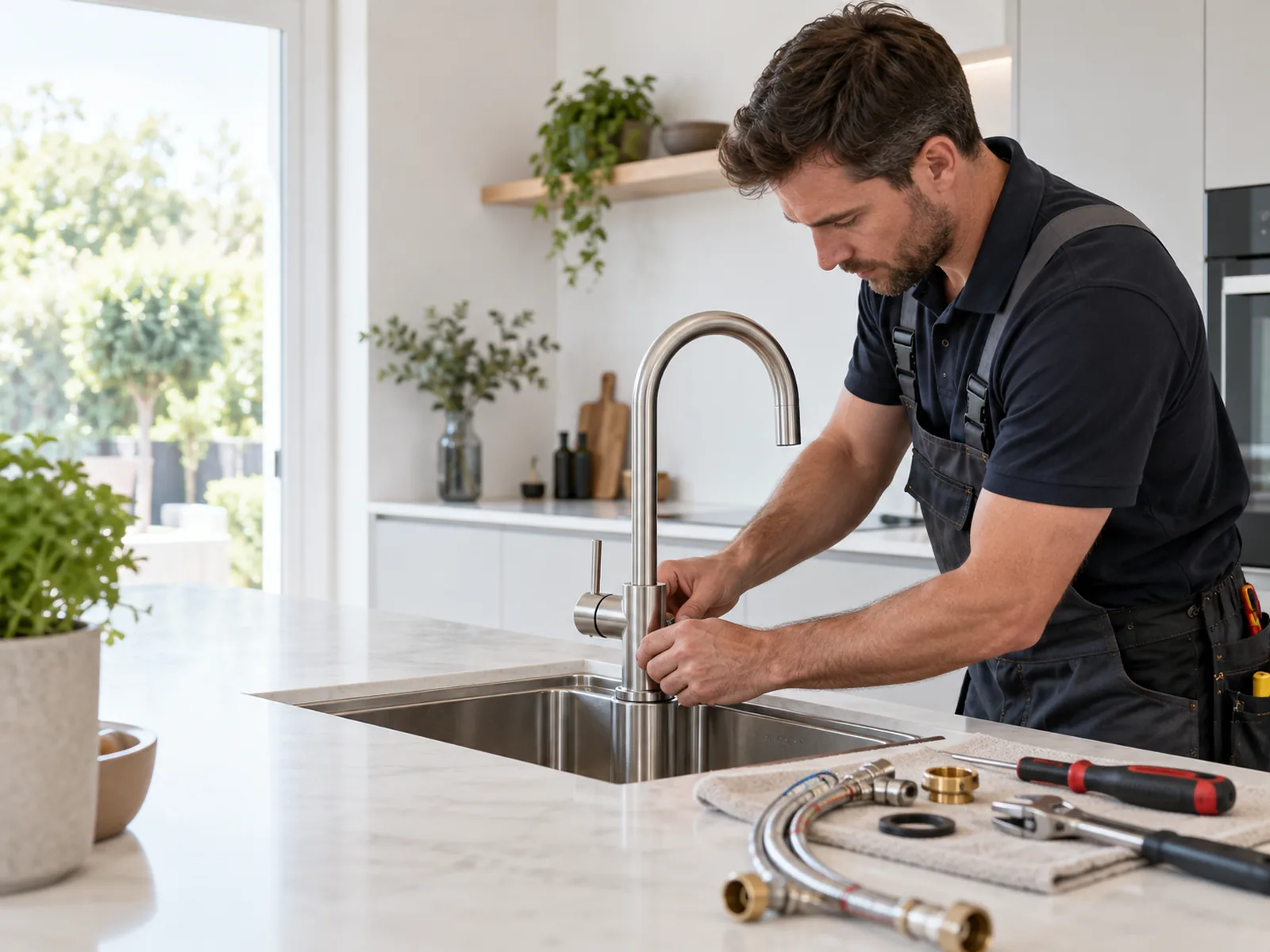
Quooker Installation Costin the Netherlands: 2026 Prices
Having a Quooker or another boiling-water tap fitted costs €150 to €300 per job in 2026, excluding VAT, when you already own the tap and water, drain and an earthed socket are present under the worktop. The tap itself is bought separately, and drilling a hole in the worktop or adding a socket is separate work.
By Arek
Updated September 10, 2026 · 21 min read
What a Quooker installation costs in 2026
Only the first line below is a reference price from our pricing model, and it is stated excluding VAT. The rest is market context: what manufacturers, retailers and Dutch job platforms publish, mostly as consumer prices with VAT already included.
| Item | Typical 2026 amount | What it covers |
|---|---|---|
| Installation only (you supply the tap, connections present) | €150 – €300 per job | Fitting tap and reservoir, connecting water, drain and power, setting and flushing |
| Dealer or kitchen-shop fitting fee with purchase | About €150 – €210 | Fixed fee, usually only for a tap bought from that dealer |
| Quooker tap and tank, appliance only | About €1,100 – €2,300 retail | Model, finish and whether you add a CUBE decide this; shop price, not a reference price |
| Tap plus installation, published totals | Up to about €3,500 | Top finishes and a CUBE for chilled and sparkling water |
| Earthed socket or extra circuit | About €80 – €450 (electrician) | Only when there is no free socket under the worktop |
| Drilling a new tap hole in the worktop | Quoted per project (kitchen fitter) | Certified Quooker fitters do not drill worktops |
Read in September 2026, the Dutch market for this job sat in a narrow band. Zoofy listed the fitting as a fixed €165 to €225. Kitchen and sanitary shops published fixed fitting packages of roughly €150 to €210, one of them listed simply as Quooker montage — montage is the word a Dutch quote uses for the fitting work, as opposed to the appliance. All of those sit inside the €150 to €300 reference band. They are observations from one month's public listings, not reference prices.
Read a quote in two halves: the labour, which is what the €150 to €300 band describes, and the appliance, which you buy in a shop or online. A single all-in number that looks cheap usually means a basic model; one that looks expensive usually means a CUBE or a stainless-steel or brushed finish. Neither tells you whether the fitting itself is well priced.
Why the labour band is as wide as it is
Swapping a mixer tap for a Quooker in a kitchen that already has the connections is one to two hours of work, and lands at the bottom of the band. A cramped sink cabinet, a reservoir that has to be repositioned, an extra drain branch or a tap you bought elsewhere that needs unfamiliar parts push it upward. Some contractors price the job as a fixed fee, others as hours plus small materials.
What has to be under the worktop before the fitter arrives
A Quooker is a plumbing job and an electrical job at the same time. Most jobs that overrun do so because one of these was missing. Check the sink cabinet — the spoelkast — against this list before you book anyone.
- A tap hole of about 35 mm in the worktop. Replacing an existing mixer tap means the hole is already there.
- A cold water connection with a stop valve — a *stopkraan* — so the reservoir can be isolated without shutting off the whole house. The reservoir is fed from the cold side; the hot connection serves the mixer part of the tap.
- Flexible connections with 3/8 inch male thread, the standard fitting under Dutch kitchen sinks.
- A 40 mm drain, and room on it for the tap's own hose. If the only drain branch is already taken by the dishwasher, you need an extra connection made.
- Space for the inlet combination — the *inlaatcombinatie*, a combined check and pressure-relief valve on the cold feed. Its relief outlet needs a short hose run to the drain, because it lets a little water out every time the tank heats up. That drip is normal; a hose that ends in the cabinet instead of the drain is not.
- A free earthed socket — a *geaard stopcontact* — within about 50 cm of the reservoir, permanently live rather than switched with a light or a timer.
- Physical room for the tank, and for a CUBE if you are adding one, with the cabinet still usable.
The socket, in plain numbers
A Quooker reservoir heats at about 1600 W on 230 V, which is roughly 7 A — not the 10 A figure that gets quoted around. It is an ordinary domestic load, comparable to a kettle, so it does not automatically need its own heavy circuit; what it does need is an earthed outlet it can keep. Dutch sockets are Type F, the round Schuko pattern, not UK Type G. If you moved here with British appliances, do not solve this with a travel adapter or an extension lead: the reservoir stays plugged in permanently and needs a fixed, earthed point.
Older Dutch kitchens, and many pre-1975 flats, have unearthed sockets in the kitchen or none at all inside the sink cabinet. That is the single most common reason a Quooker job needs a second trade.
Water supply, drainage and room in the cabinet
The plumbing side of a boiling-water tap is undramatic, which is exactly why quotes tend to assume it. It is worth knowing what the fitter is actually connecting, because two of the three things below decide whether the job stays inside one visit.
The cold feed, the stop valve and water pressure
The reservoir is fed from the cold water pipe through its own shut-off valve — a stopkraan — so the tank can be isolated without draining the rest of the house. If the cabinet has no valve, have one fitted during the installation; retrofitting it later means shutting off the mains a second time. Reckon on at least about 2 bar of pressure at the tap. In a high-rise flat, or a house with narrow old pipework, that is something to have measured rather than assumed.
Whether a hot connection is needed as well depends on the tank. A boiling-only reservoir and the combined reservoir that also supplies the kitchen's ordinary hot water both run from the cold feed alone. The larger combined unit is connected to cold and hot, which is another joint to make and a little more time on the invoice.
Why the drain usually stays as it is
The existing trap and waste pipe normally stay where they are. A boiling-water tap is not a reason to rebuild the drainage. What is added is the inlaatcombinatie, the combined check and pressure-relief valve on the cold feed. Water expands as the tank heats, and that valve lets the surplus out — through an open funnel and a short hose tapped into the existing waste pipe.
The gap between funnel and drain is deliberate, not unfinished work: drinking water must not be joined to the waste system by a closed connection. A new drain branch is only needed where the single branch available is already occupied, which in a Dutch kitchen usually means the dishwasher has it.
Space around the reservoir
The tank has to stand upright and stay reachable, because filter changes and the occasional descale are done in place. Deep undermount sinks, pull-out waste systems and full drawers are the usual reason a montage appointment overruns or that a carpenter ends up involved. Measure the clear space in the spoelkast before you order, and include the footprint of a chilled-and-sparkling unit if you intend to add one.
Do you need an electrician as well?
Sometimes. Certified Quooker fitters connect the reservoir to an existing power point but do not create one, and they do not work in the consumer unit — the meterkast. Plenty of general plumbers will not either. If the socket is missing, unearthed or occupied, that work is quoted separately.
- Adding a socket on an existing kitchen circuit that already runs nearby is the cheap end of the €80 to €450 the guides quote.
- Pulling a new circuit from the consumer unit, especially through a finished kitchen, is the expensive end.
- An unearthed kitchen group has to be earthed properly rather than swapped for an earthed-looking socket with no earth behind it.
- In an apartment, check whether the consumer unit is inside your home or in a shared technical space before you assume the electrician can reach it.
Book the electrician first and the tap fitter after. Reversing the order usually means paying for two visits from the same person.
Reservoir types and tap layout
Two choices sit behind the number on the quote: which tank goes in the cupboard, and how the tap sits on the worktop. The first mostly moves the appliance price. The second can move the labour a long way.
| Reservoir | What it delivers | Water connections | Electrical load |
|---|---|---|---|
| Boiling only (PRO3 in Quooker's own labelling) | Boiling water at the dedicated tap | Cold feed | About 1600 W, roughly 7 A; a dedicated group is generally not needed |
| Boiling plus hot (COMBI) | Boiling water and the kitchen's ordinary hot water from the same tank | Cold feed | About 1600 W, roughly 7 A; a dedicated group is generally not needed |
| Larger combined unit (COMBI+) | Boiling water and a bigger hot-water supply | Cold and hot | Draws more; usually wants its own group |
| Chilled and sparkling accessory | Cold filtered and carbonated water | Runs off the same cold supply | A second unit in the cabinet, plus a CO2 cylinder |
The names differ by manufacturer, but the categories do not: a tank that only boils, a tank that boils and supplies hot water, and a heavier unit that replaces the kitchen's hot-water supply outright. Check what yours needs before the appointment, because it decides whether the fitter is making one water connection or two.
A combi tap or a separate boiling-water tap
A combi tap replaces your existing mixer and does everything from one spout. It looks tidier on the worktop and it uses the tap hole that is already there. A separate boiling-water tap stands beside the mixer you keep, which can be cheaper on the appliance, but it needs a second hole — a spare one in the sink, or a new one drilled in the worktop.
That hole is where the money hides. Drilling composite, ceramic or natural stone is specialist work, quoted per project, and normally done by whoever supplied the worktop; certified tap fitters do not drill worktops. A straight swap of mixer for combi tap needs no drilling at all, which is why it lands at the bottom of the €150 to €300 band.
Chilled and sparkling water
An extra unit for chilled and sparkling water means a second box in the cupboard, a CO2 cylinder to house and refill, and more fitting time. Decide before the appointment rather than during it: adding one later means opening the cabinet up and paying for a second visit.
Replacement or first installation?
These are two different jobs with the same headline price, and the difference sits almost entirely in the preparation.
| Replacing an existing mixer tap | First installation in this kitchen | |
|---|---|---|
| Tap hole | Already there, usually 35 mm | Has to be drilled by the kitchen fitter |
| Water connections | Present, sometimes need new flexibles | Present in almost every Dutch kitchen |
| Drain | Present; may need a branch for the tap hose | Present; branch often still needed |
| Socket | Often present, sometimes unearthed | Frequently missing altogether |
| Typical labour | Bottom of the €150 – €300 band | Top of the band, plus other trades |
| Extra trades | Rarely | Electrician, sometimes a kitchen fitter |
If you are renting, ask the landlord before anyone drills. A boiling-water tap changes the worktop and adds a permanent appliance in the cabinet, and Dutch tenancy practice treats a worktop hole as a change to the property rather than ordinary use.
Fit it yourself, or have it done?
Quooker states on its own service pages that a plumber is not required and that the installation can be done by the owner; the manual ships with the tap. The work is fitting the tap and the reservoir, connecting cold water through the stop valve and the inlet combination, running the relief hose to the drain, plugging in and flushing the system once before first use.
The argument for paying someone is not difficulty, it is consequence. The reservoir sits in a closed cabinet next to an electrical point, and a connection that weeps rather than sprays can run for weeks before it is noticed. If you are not comfortable making a compression joint and pressure-testing it, the €150 to €300 buys a tested installation and someone to call if it leaks.
- Quooker's manufacturer warranty is two years and its own pages do not make it conditional on professional installation; dealers sometimes attach extra warranty to their own fitting.
- Do not feed a Quooker from reverse osmosis or from a softener that takes the pH below 7 — that shortens the life of the tank.
- Empty the sink cabinet before the appointment and know where the main stopcock is.
- Extra materials taken from the van are normally charged on top, after asking you.
Filters, descaling and running costs
A boiling-water tap is not a fit-and-forget appliance. A few small recurring costs start on the day it goes in, and none of them appear on the installation quote.
- Filter replacement. The tank carries a filter that is changed periodically. It is a small part, and usually a job you can do yourself provided the reservoir is reachable.
- Descaling. How often depends on how hard your water is. In hard-water parts of the country the first sign is slower reheating.
- A leak check. Twice a year, look into the cabinet with a torch: funnel dry apart from the expected drops after heating, joints dry, no staining on the cupboard floor.
- CO2 cylinders, if you have the sparkling accessory. That is a standing cost, not a one-off.
- Electricity. The tank holds a small volume of water at temperature around the clock, so there is a modest but continuous draw even on days you do not use it.
Follow the maintenance interval in your own model's documentation rather than a rule of thumb from a forum: it varies by tank and by local water hardness. This guide carries no reference price for servicing a boiling-water tap. Where a professional is called out for it, the ordinary planned daytime rate of €45 to €85 per hour applies, plus a call-out charge where one is charged. Amounts exclude VAT. Whether VAT is added depends on the contractor: one using the small-business scheme (KOR) charges none.
Other boiling-water tap brands
In the Netherlands Quooker is used the way Hoover once was in Britain — as the name of the category rather than of one product. It is a Dutch brand, and the best known, but Grohe (Red), Franke and InSinkErator all sell boiling-water taps with an under-sink tank, and kitchen suppliers carry their own lines.
For the fitting price the brand barely matters. The work has the same shape every time: hang the tap, mount the tank in the cabinet, take a cold feed through a stop valve, route the expansion water to the drain, plug into an earthed socket, set the temperature and flush through. The €150 to €300 reference range is for fitting a boiling-water tap, not for one manufacturer's product.
What does differ is tank dimensions, filter and maintenance schedules, and warranty conditions — some manufacturers and dealers attach conditions to who carries out the installation. Read your own brand's terms before you book, particularly if you bought the tap secondhand or from a marketplace seller. If a contractor has never handled that brand, say so when you request the quote rather than on the day.
How to read a Quooker quote
- Ask whether the amount is excluding or including VAT, and whether call-out and small materials are inside it. Platform and shop prices are usually shown with VAT; a contractor's quote often is not.
- Say up front whether this is a replacement or a first installation, and whether there is a free earthed socket in the cabinet. It is the difference between one visit and three.
- Send a photo of the open sink cabinet and one of the worktop around the tap. It costs you a minute and removes most of the guesswork.
- With a dealer, check whether the fitting fee applies only to a tap bought there, and what the fee includes if the job turns out to need more than an hour.
- Arrange the worktop hole and the socket separately and beforehand. The Quooker fitter does neither.
- Ask for the price of a second visit in writing, in case something under the sink is not what the photo suggested.
Frequently asked questions
Answers to common questions.
How much does it cost to have a Quooker installed?
Fitting a boiling-water tap you already own costs €150 to €300 per job, excluding VAT, when water, drain and an earthed socket are already in the sink cabinet. Whether VAT is added depends on the contractor: one using the small-business scheme (KOR) charges none. Drilling a tap hole or adding a socket is charged separately.
Is the tap included in that price?
No. The €150 to €300 is labour only. Common Quooker models retail at roughly €1,100 to €2,300, and a set with a CUBE for chilled and sparkling water or a premium finish takes published tap-and-installation totals up towards €3,500. The appliance is by far the larger number.
Does the €150 to €300 apply to boiling-water taps other than Quooker?
Yes. The reference range covers fitting a boiling-water tap with an under-sink reservoir, whichever brand it is — Grohe Red, Franke and InSinkErator among others all install along the same lines: tap on the worktop, tank in the cabinet, cold feed through a stop valve, expansion water to the drain, plug into an earthed socket. What varies between brands is tank size, filter schedules and warranty conditions, not the shape of the work.
What has to be in place before the fitter arrives?
A tap hole of about 35 mm, which already exists if you are replacing a mixer tap; cold and hot connections with 3/8 inch male thread and a stop valve (stopkraan) on the cold feed; a 40 mm drain with room for the tap hose and the inlet combination's relief hose; a free earthed socket within about 50 cm of the reservoir; and space in the cabinet. Certified fitters do not drill worktops and do not create electrical points.
What kind of socket does a Quooker need?
An earthed one — a geaard stopcontact, the Dutch Type F/Schuko pattern, not a UK Type G socket or an adapter. The reservoir heats at about 1600 W on 230 V, which is roughly 7 A, so it is an ordinary domestic load rather than something needing a heavy dedicated circuit. What matters is that the socket is earthed, permanently live and not shared with a switch or timer.
What if there is no socket under the worktop?
Then an electrician goes first, sometimes adding a circuit in the consumer unit. Guides put that at roughly €80 to €450 depending on the distance to the consumer unit and whether a new circuit is needed. The Quooker fitter connects to an existing point but will not create one.
Does a Quooker need its own group in the consumer unit?
Usually not. A boiling-only or combined reservoir draws about 1600 W at 230 V, roughly 7 A, and a Dutch kitchen group is typically rated at 16 A, so a dedicated group is generally not required for it. The larger combined unit that also supplies the kitchen's hot water draws more and in practice is better with a group of its own. Let an electrician judge it against what is already on the circuit.
What if the dishwasher or the oven is on the same group?
Then the two running together can trip the breaker. There are two proper fixes: have an extra group installed in the meterkast, or use the manufacturer's power-management accessory, which briefly holds the reservoir back while the other appliance is drawing. Which of the two is possible depends on your consumer unit, so let the electrician decide. An extension lead or a plug strip is not a fix.
What water connections does the reservoir need?
A cold feed with its own shut-off valve — a stopkraan — so the tank can be isolated without draining the house, and at least about 2 bar of pressure. A boiling-only tank and the combined tank that also gives ordinary hot water run from cold alone; the larger combined unit is connected to cold and hot. Under Dutch kitchen sinks the connections are normally flexibles with 3/8 inch male thread.
Does the drain have to be modified?
Normally not. The existing trap and waste pipe stay as they are. What is added is the inlet combination (inlaatcombinatie) on the cold feed, whose relief outlet discharges expansion water through an open funnel and a short hose tapped into the existing waste pipe. A new branch is only needed where the one branch available is already taken, typically by a dishwasher.
What is that extra hose to the drain for?
It belongs to the inlet combination (inlaatcombinatie), the combined check and pressure-relief valve on the cold feed to the reservoir. Water expands as the tank heats, and the valve lets a little out each cycle. The relief outlet must run to the drain. A small drip there is normal; a hose ending inside the cabinet is a problem.
How long does the installation take?
Usually one to two hours for a replacement with all connections present, and longer where there is more work — a new drain branch, a repositioned reservoir or a CUBE. After fitting, the tank is flushed once before first use, which adds ten to twenty minutes.
Can I install a Quooker myself?
Yes. Quooker states on its own service pages that a plumber is not required and supplies the manual. Many people still use a plumber or a certified fitter, because the reservoir sits in a closed cabinet next to an electrical point and a slow weep can go unnoticed. The manufacturer warranty is two years and Quooker's own pages do not make it conditional on professional installation; dealers sometimes attach extra warranty to their own fitting.
What does a boiling-water tap cost to keep running?
Filters at the interval your model's documentation gives, descaling in hard-water areas, electricity to hold a small tank at temperature around the clock, and CO2 cylinders if you have the sparkling accessory. This guide carries no reference price for servicing. Where you call a professional out for it, the ordinary planned daytime rate of €45 to €85 per hour applies, plus any call-out charge. Amounts exclude VAT. Whether VAT is added depends on the contractor: one using the small-business scheme (KOR) charges none.
Do I pay 9% or 21% VAT on the installation?
Plumbing and installation labour falls under the general 21% rate. The reduced 9% rate applies to specific work on homes older than two years — painting, plastering, wallpapering and insulating — and does not cover plumbing. Prices on this page are stated excluding VAT. Whether VAT is added at all depends on the contractor: one registered under the small-business scheme, the kleineondernemersregeling or KOR, charges none. Ask which basis a quoted amount uses before comparing it with another.
Compare quotes
Describe the job once and compare responses from independent contractors. Worth including: whether it is a replacement or a first installation, the model of tap you have bought or plan to buy, whether there is a free earthed socket in the sink cabinet, and a photo of the cabinet with the doors open plus one of the worktop around the tap. For general rates, read the Plumber Cost Guide. If you are also replacing the kitchen tap elsewhere in the house, see the Tap Replacement Cost Guide. SkilledContractors is a comparison platform. It does not carry out the work, set the final price, or guarantee availability, response times or workmanship. Agree the scope and the price in writing before the work starts.