Toilet Installation Cost in the Netherlands: 2026 Prices
The toilet installation cost in the Netherlands splits into two parts: the labour and the toilet itself. For a like-for-like replacement on existing connections, labour is normally €100 to €300 per job and a standard toilet unit €100 to €400 per item, both excluding VAT. A wall-hung model with a concealed cistern, or moving the toilet, costs more because of the frame, the pipework and the wall finishing.

By Arek
Updated October 6, 2026 · 17 min read
Quick answer
Toilet replacement (labour only, existing connections)
Excludes the toilet; disposal of the old toilet and pipework changes extra
€100 – €300 per job
planned, daytime · excl. VAT · VAT depends on the provider
National reference range, not a measured city price.
Amounts exclude VAT. Whether VAT is added depends on the contractor: one using the small-business scheme (KOR) charges none.
- Labour:
- included
- Materials:
- not included
- Call-out:
- depends on the provider
Related, priced separately
- Toilet unit (appliance only, standard floor-standing or wall-hung) — €100 – €400 per itemtiming not stated · excl. VAT · VAT depends on the provider
Toilet installation cost overview
The table gives a practical starting point for estimating the cost to install a toilet in an existing Dutch home. It separates the two things a quote actually prices: the work, and the toilet.
| Type of work | Indicative price (excluding VAT) | Basis |
|---|---|---|
| Toilet replacement, like-for-like on existing connections | €100–€300 | Labour only, per job |
| Toilet unit, standard floor-standing or wall-hung | €100–€400 | Appliance only, per item |
Amounts exclude VAT. Whether VAT is added depends on the contractor: one using the small-business scheme (KOR) charges none. These ranges are indicative. They are not an offer, not a guaranteed price, they do not set your budget and they do not bind a contractor: the final quote may be lower or higher.
What a complete job tends to total
Complete-job totals are a different thing from the reference prices above. The figures below are Dutch market context, not reference prices: each one bundles labour, the unit, fittings and finishing work, and there is no fixed unit behind them, so they are quoted per project.
- a floor-standing toilet supplied and installed: roughly €300 to €700;
- a wall-hung toilet with frame and concealed cistern: roughly €700 to €1,500;
- a complex or premium wall-hung installation: €1,500 to €2,500 or more;
- removing and disposing of the old toilet: roughly €50 to €150;
- a minor water or waste-pipe adjustment: roughly €75 to €300;
- moving the toilet or installing new waste pipework: €500 to €1,500 or more;
- tiling, plastering or wall and floor restoration: quoted per project.
The new toilet installation cost is usually lowest when the new model fits the current connections, because none of the pipework or finishing items above are triggered.
New toilet options
Common toilet options include a close-coupled toilet, a one-piece toilet, a back-to-wall model and a wall-hung toilet. A standard toilet with an exposed toilet tank is normally easier to fit than a model with the cistern concealed inside the wall.
A smart toilet or bidet model can cost more because it may need electricity or extra water fittings. Ask the plumber or toilet installer which type of toilet fits the available space and current waste outlet before you purchase the toilet.
Toilet installation versus toilet replacement
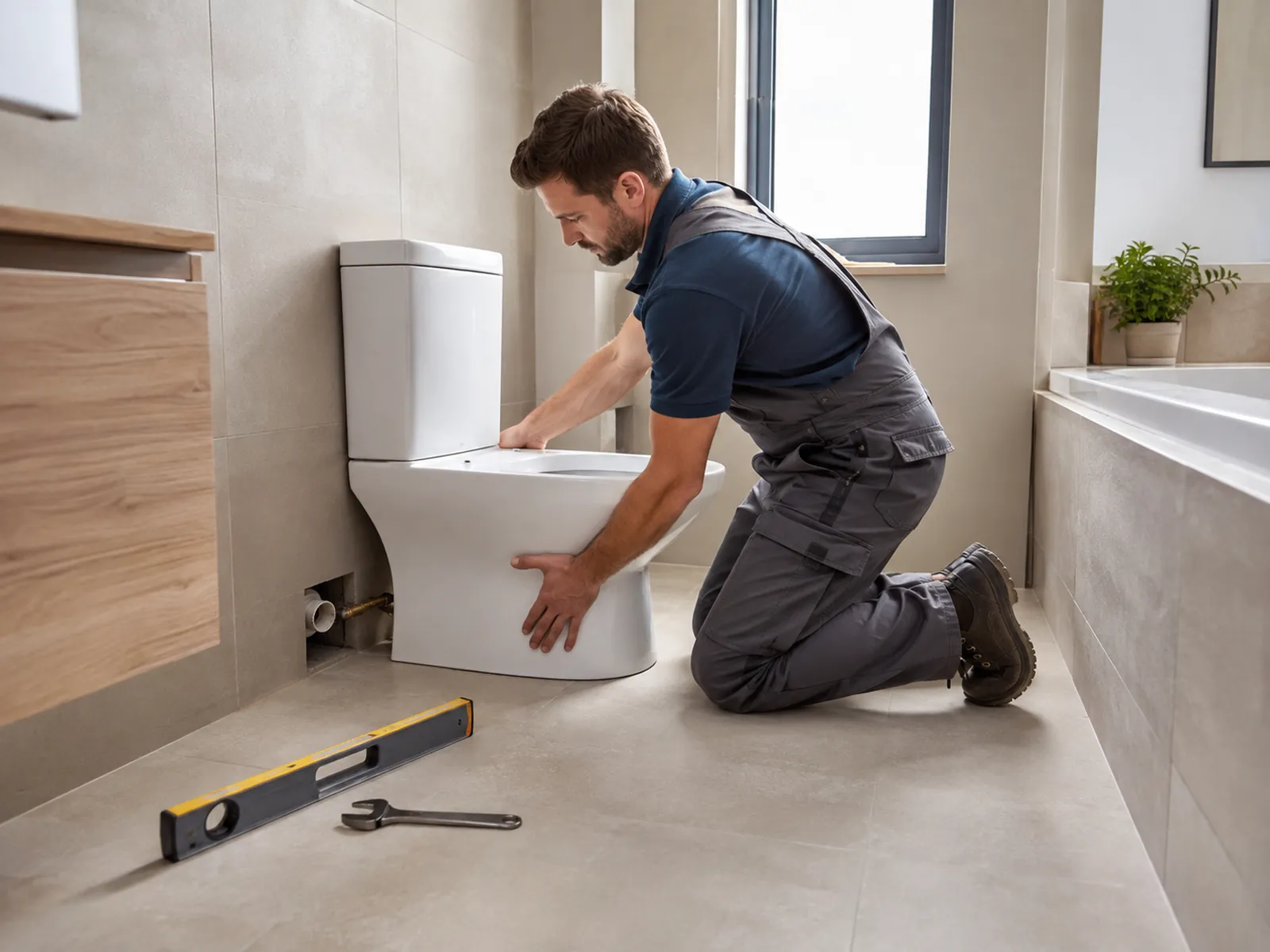
A toilet replacement means removing the existing toilet and fitting a compatible model in the same position. This is usually the least expensive option because the water supply and waste outlet can remain, and it is the scope the €100 to €300 labour reference describes.
A new toilet installation can involve more work. The installer may need to move a water line, adjust the waste connection or build a wall section. The toilet replacement cost is usually lower than the cost of installing a toilet in a new position.
Floor-standing toilet cost
A floor-standing or close-coupled toilet is fixed to the floor. The cistern may sit behind the toilet bowl or form part of the same toilet unit.
This is often the easiest type of toilet to install. The unit itself sits in the €100 to €400 reference band and the labour in the €100 to €300 band, both excluding VAT; supplied and installed, Dutch market totals commonly land around €300 to €700.
Wall-hung toilet installation cost
A wall-hung toilet is attached to a mounting frame. The cistern is concealed inside the wall or a boxed structure. A flush plate provides access to the controls.
The installation can include:
- mounting and levelling the frame;
- installing the concealed cistern;
- connecting water and waste;
- closing the wall section;
- fitting the toilet bowl and flush plate;
- sealing and leak testing.
There is no reference labour rate for this scope: the frame, wall work and finishing are quoted per project. As market context, a basic wall-hung job totals about €700 to €1,500 supplied and installed. Premium sanitary ware, pipe changes or extensive tiling can raise it.
Concealed cistern and mounting frame
A wall-hung toilet requires a suitable frame and cistern. Check whether the quote includes:
- mounting frame;
- concealed cistern;
- flush plate;
- toilet bowl;
- toilet seat;
- connection parts;
- wall finishing.
A low toilet price can become a much higher project price when these items are not included.
What affects the cost?
The main toilet installation cost factors are the type of toilet, compatibility with the existing plumbing and the amount of finishing work.
Like-for-like replacement
The lowest price normally applies when the new toilet has a similar size and connection layout to the old toilet.
Before you buy, ask the installer to confirm:
- whether the waste outlet exits through the floor or wall;
- the water-supply location;
- the available space;
- whether the wall or floor is suitable;
- whether the selected model fits the current connection.
Buying an incompatible model can lead to extra fittings, pipe adjustment or a different toilet choice.
Moving the toilet position
Moving the toilet can greatly increase the cost. The waste pipe needs the correct route and fall, while the water supply must reach the new position.
The work may involve opening the floor or wall, installing a new waste line and restoring tiles. This overlaps with a broader toilet-room or bathroom project and is quoted per project.
For a complete room rebuild, use the Bathroom Renovation Cost Guide rather than treating it as a simple toilet installation.
Condition of the existing connections
Removing an old toilet can reveal damaged fittings, a worn shut-off valve, a leaking connection or an uneven floor.
Ask how unexpected repairs will be priced. The quote should state that additional work needs your approval before it begins.
When should you replace your current toilet?
You may need a new toilet when the current toilet has cracked porcelain, repeated leaks, an unstable base or a flush system that cannot be repaired reliably.
A worn valve or running toilet may only need a smaller repair. Compare the repair price with the cost to replace a toilet before deciding.
The price depends on features such as:
- floor-standing or wall-hung design;
- close-coupled or concealed cistern;
- rimless bowl;
- dual-flush system;
- soft-close toilet seat;
- comfort-height model;
- bidet function;
- smart toilet controls.
The €100 to €400 unit reference covers a standard floor-standing or wall-hung toilet. Rimless, comfort-height, designer and smart models sit above it, and that is a material cost rather than a labour cost.
A smart toilet or bidet toilet may need an electrical connection. Electrical work is not normally part of standard plumbing installation.
Wall, floor and tile work
A wall-hung conversion can require a frame, wall enclosure and new tiles. A new floor-standing model can also leave a different footprint when the old toilet is removed.
Ask whether plastering, painting or tiling are included.
Access and working space
A small toilet room, stairs, apartment access, paid parking and restricted hours can affect the cost estimate.
Provide photos and measurements before requesting a quote.
Hourly rate, fixed price or project price?
A simple toilet replacement is often offered at a fixed price. An hourly rate may apply when the plumbing condition is uncertain. A project price suits work with a frame, pipe changes and finishing.
Labour cost to install a toilet
The labour cost for a simple replacement is commonly about €100 to €300 excluding VAT when the customer supplies a compatible toilet. This covers labour only — the toilet itself, disposal of the old unit and any pipework changes are priced separately.
A standard replacement often takes around 2 to 4 hours. A wall-hung installation, concealed pipework or damaged connections can require more time.
Ask whether labour includes:
- disconnecting the old toilet;
- removing it from the room;
- fitting the new toilet;
- connecting water and waste;
- sealing and testing;
- basic cleanup.
Amounts exclude VAT. Whether VAT is added depends on the contractor: one using the small-business scheme (KOR) charges none.
Where the toilet itself sits
A standard toilet unit is a separate €100 to €400 per item, excluding VAT. When a provider quotes one combined number, ask them to split it, so you can compare labour against labour.
To put the labour element in context, compare general plumber rates and call-out charges and confirm which charges apply to your toilet installation quote.
A fixed price should identify:
- toilet model;
- mounting materials;
- cistern and flush plate;
- toilet seat;
- removal and disposal;
- fittings;
- travel and parking;
- whether VAT is charged.
Hourly rate
Ask for:
- the hourly rate;
- minimum charge;
- call-out fee;
- expected number of hours;
- material markup;
- approval before additional hours.
A low hourly rate does not guarantee a low total cost.
Fixed price for the swap
A like-for-like replacement is often quoted as one fixed labour price, normally about €100 to €300 excluding VAT. Confirm in writing what that figure covers.
Project price
A project price is useful for a wall-hung toilet, concealed cistern or location change. It should separate plumbing, building and finishing work.
Example prices
These examples show how scope affects the cost. They are not fixed offers.
Install a customer-supplied toilet
Labour for a straightforward installation is usually about €100 to €300 excluding VAT, and excluding the toilet itself.
Confirm compatibility before buying. The installer may refuse to fit an incomplete, damaged or unsuitable product.
Buy the toilet yourself
A standard floor-standing or wall-hung toilet unit sits at about €100 to €400 excluding VAT.
A mounting frame, concealed cistern and flush plate are extra, and premium sanitary ware goes well above that band.
Replace a floor-standing toilet in the same position
A supplied-and-installed replacement lands around €300 to €700 in the Dutch market, including a basic or mid-range toilet. That is a complete-job total, not a reference price.
The lower end assumes easy access and no pipe, floor or wall repair.
Replace an existing wall-hung toilet bowl
Replacing only the bowl can cost less when the current frame and concealed cistern are compatible and in good condition.
A new frame or cistern is a separate scope.
Convert a floor-standing toilet to a wall-hung toilet
A conversion commonly totals about €700 to €1,500 for a standard frame, cistern, bowl and installation.
A complex or premium project can reach €1,500 to €2,500 or more. Both are market totals for the whole project and are quoted per job.
Install a toilet in a new position
Adding a second toilet or moving the existing toilet often requires new water and waste lines, floor opening and wall work.
This is not a simple per-toilet replacement. Ask for a project quote based on the layout.
Install a smart toilet or bidet toilet
A smart toilet can need both water and electricity. Confirm who provides the electrical connection and any additional valves.
What is included?
A standard toilet installation may include:
- checking the connections;
- shutting off the water;
- disconnecting the old toilet;
- preparing the existing connection;
- securing the new toilet;
- connecting water and waste;
- fitting the cistern;
- installing the toilet seat;
- sealing where required;
- testing the flush;
- checking for leaks;
- basic cleanup.
The exact installation work depends on the type of toilet. A toilet installer should check the supply line, waste connection and flush operation before finishing.
Wall-hung installation scope
The quote may also include:
- mounting frame;
- concealed cistern;
- waste and water connections;
- flush plate;
- toilet bowl;
- wall enclosure;
- final testing.
Do not assume that tiles, plastering or painting are included.
Supply of the toilet
Some quotes include the new toilet. Others cover labour only. The €100 to €300 reference range is the labour-only case; add about €100 to €400 for a standard unit when you are buying it yourself.
Ask for the brand, model, colour, seat, flush plate and product warranty. When you supply the unit, ask the installer to confirm the exact model before ordering.
A standard installation price often excludes:
- the toilet unit itself, when the quote is labour only;
- moving the toilet;
- long new waste pipework;
- extensive water-pipe changes;
- damaged floor or wall repair;
- tiling, plastering and painting;
- electrical work;
- mould or water-damage repair;
- full toilet-room renovation;
- removal and disposal unless stated;
- parking and call-out fees unless stated;
- VAT, where the contractor charges it;
- guaranteed same-day attendance;
- guaranteed workmanship unless offered in writing by the provider.
Full toilet renovation
A complete toilet room can include flooring, wall tiles, a basin, lighting, ventilation and several connections. That is a broader renovation intent and is quoted per project.
Blocked toilet or drain cleaning
A clog is not automatically a reason to replace the toilet. A blocked toilet may require drain unblocking instead.
This guide does not cover the cost of clearing a blockage or repairing a main drain.
Saving tips
The best savings come from choosing a compatible toilet and comparing the same written scope.
Keep the toilet in the same position
A like-for-like replacement normally costs less because the current water and waste connections can stay.
Ask for labour and unit separately
Labour for a like-for-like swap is normally €100 to €300 and a standard toilet €100 to €400, both excluding VAT. Split quotes are the only ones you can compare like for like.
Confirm compatibility before buying
Send photos, dimensions and the product link. Confirm whether the bowl, cistern, frame, flush plate and seat are complete.
Choose a standard model
A standard floor-standing toilet is usually easier to install and repair than a concealed or smart model.
Prepare the room
Clear the route and remove loose items. Do not disconnect plumbing unless you can isolate the water safely and the installer agrees.
Compare the same quote items
Compare:
- unit price;
- labour;
- removal;
- disposal;
- mounting parts;
- pipe adjustments;
- surface work;
- travel and parking;
- whether VAT is charged;
- follow-up terms.
Can I install a toilet myself?
Incorrect alignment or sealing can cause leaks, smells and floor damage. Toilets are also heavy and difficult to lift safely.
Hire a professional when pipework changes, the floor is damaged, the toilet is wall-hung or the installation includes a concealed cistern.
Local costs and call-out charges
Prices can vary by location, parking and provider availability.
Large Dutch cities
Paid parking and restricted access can affect quotes in Amsterdam, Rotterdam, The Hague and Utrecht.
Ask whether parking and travel are included.
Rental property
A tenant should normally obtain the landlord's permission before changing a fixed sanitary fixture. Responsibility depends on the reason, tenancy agreement and whether the work is a minor repair or a larger renewal.
The Dutch government explains the general division of maintenance duties in its guidance for landlords and tenants.
Apartment and VvE
Moving a waste connection or working on a shared riser can require VvE or property-manager approval.
Check access rules and planned water shutoffs before booking.
VAT and additional charges
Ask whether VAT, call-out fees, parking, waste disposal and material markup are included.
Plumbing and installation labour falls under the standard 21% VAT rate. The reduced 9% rate covers work such as painting, plastering, wallpapering and insulating homes older than two years, and does not apply to toilet installation.
Amounts exclude VAT. Whether VAT is added depends on the contractor: one using the small-business scheme (KOR) charges none.
A worked example
You buy a standard floor-standing toilet for €250 and a plumber swaps it on the existing connections for €200 of labour. That is €450 before VAT. A contractor who charges VAT adds the standard 21% rate, taking the bill to €544.50; a contractor using the small-business scheme (KOR) charges none, so the bill stays €450.
Removal and disposal of the old toilet, a new shut-off valve or a pipe adjustment would each be an extra line on top.
Frequently asked questions
Answers to common questions.
How much does toilet installation cost in the Netherlands?
It depends on what the price covers. As a reference, labour for a like-for-like replacement on existing connections is normally €100 to €300 and the toilet unit itself €100 to €400, both excluding VAT. Complete supplied-and-installed jobs in the Dutch market run higher — roughly €300 to €700 for a floor-standing toilet and €700 to €1,500 for a wall-hung toilet with a concealed cistern — because those totals also carry the frame, fittings and finishing work.
What is the labour cost for installing a toilet?
Labour for a simple like-for-like replacement on existing connections is normally about €100 to €300 (labour only — the toilet itself, removal and disposal of the old unit, and any pipework changes are separate; whether VAT and a call-out fee are charged depends on the provider). Wall-hung installation with a concealed cistern is more complex and sits at or above the top of that band.
How much does it cost to replace a toilet?
The cost to replace a toilet depends on the type and whether the existing connections can stay. A like-for-like replacement is normally cheaper than moving the toilet: budget about €100 to €300 for the labour plus €100 to €400 for a standard unit, excluding VAT.
Does the price include the toilet itself?
Not always, and this is the single most common mismatch between quotes. The €100 to €300 reference range is labour only. Ask explicitly whether the unit, seat, flush plate and mounting materials are inside the price or billed on top.
How long does it take to install a toilet?
A standard replacement often takes around 2 to 4 hours. Wall-hung installation or damaged pipework can take longer.
Is removing the old toilet included?
Not always. Ask whether disconnection, removal and disposal are included.
What is the difference between a floor-standing and wall-hung toilet?
A floor-standing toilet is fixed to the floor. A wall-hung toilet uses a frame and concealed cistern, so installation is more complex.
Can I replace only the toilet bowl?
Sometimes, when the bowl is compatible with the current cistern, frame and connections.
Can I use the new toilet immediately?
Follow the installer's instructions. Sealant or finishing materials may need time to cure.
When should I replace my toilet?
Replacement may make sense when the porcelain is cracked, leaks repeat, the base is unstable or repair parts are no longer compatible.
Is a wall-hung toilet more expensive?
Yes. The frame, concealed cistern, wall work and longer installation raise the cost.
Does the price include the toilet seat and flush plate?
Not always. Check the product list carefully.
Can a handyman install a toilet?
A simple replacement may be within some handymen's experience, but pipe changes and sanitary connections require suitable plumbing knowledge.
What hidden costs should I expect?
Possible extras include damaged valves, unsuitable waste connections, uneven floors, water damage, removal, disposal and surface repair.
Is toilet installation part of a bathroom renovation?
It can be, but this guide covers the toilet and its direct connections only. A complete room renovation has a broader scope.
What should a written quote include?
It should list the toilet model, labour, materials, removal, disposal, pipe changes, finishing, travel, timing and approval for extra work. It should also state whether VAT is charged: the amounts in this guide exclude VAT, and a contractor using the small-business scheme (KOR) charges none.
Related guides
- Quooker tap cost: installation and fitting in the Netherlands
- Emergency Plumber Cost in the Netherlands: 2026 Call-Out Rates
- Leak Repair Cost in the Netherlands: 2026 Pipe and Detection Prices
- Water Pipe Installation and Replacement Cost in the Netherlands: 2026 Prices
- Boiler Maintenance Cost in the Netherlands: 2026 Service Prices
- Drain Unblocking Cost in the Netherlands: 2026 Prices
- Radiator Replacement Cost in the Netherlands: 2026 Prices
- New boiler replacement cost and installation in the Netherlands
Compare quotes
For broad plumbing work and installation requests, visit Plumbing Services. For general rates and other plumbing costs, read the Plumber Cost Guide. Hire a professional when the installation needs new pipework, a concealed frame or repair of the existing connection. SkilledContractors is a comparison platform. Describe the current toilet, preferred model, connections and finishing work, then compare responses from independent providers. Ask each provider to split labour from the unit and to state whether VAT is charged. SkilledContractors does not install toilets, set the final price or guarantee availability or workmanship. Agree the scope, timing and payment terms directly with the selected provider.